
Search
Did you mean: Tomb?
Remove Ads
Advertisement
Search Results
Definition
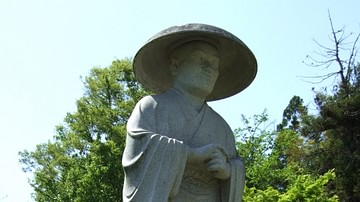
Ennin
Ennin (c. 793-864 CE, posthumous title: Jikaku Daishi) was a Japanese Buddhist monk of the Tendai sect who studied Buddhism at length in China and brought back knowledge of esoteric rituals, sutras, and relics. On his return, he published...
Image
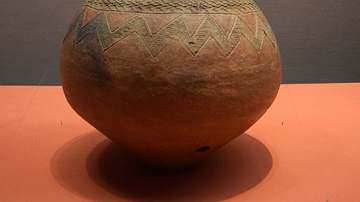
Yayoi Period Jar
A jar of the Yayoi Period, 1st-3rd century CE. From Kugahara, Ota-ku, Tokyo. Important Cultural Property. (Tokyo National Museum)
Article
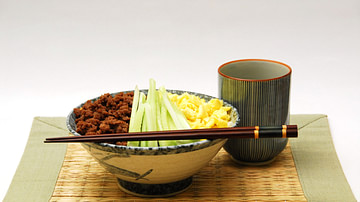
Food & Agriculture in Ancient Japan
The diet of ancient Japan was heavily influenced by its geography as an archipelago, foodstuffs and eating habits imported from mainland Asia, religious beliefs, and an appreciation for the aesthetic appearance of dishes, not just the taste...

Article
The Transatlantic Zeppelins - A Golden Age of Air Travel
Transatlantic Zeppelins carried passengers in relative luxury between Germany and New York or Rio de Janeiro during the 1920s and 1930s. The airships Graf Zeppelin and Hindenburg crossed the Atlantic in two or three days, faster than contemporary...

Article
Japanese Castles
Fortifications of one kind or another had been used in Japan since ancient times, but in the period from 1576 until 1639, a new and distinctive style of castle was constructed. Rather than being used for fighting, these were impressive structures...

Article
The Ajanta Caves
The 30 caves at Ajanta lie to the north of Aurangabad in the Indhyadri range of Western Ghats. The caves, famous for their temple architecture and many delicately drawn murals, are located in a 76 m high, horseshoe-shaped escarpment overlooking...

Article
Buddhist Illuminated Scripts of Ancient Korea
The Goryeo (Koryo) kingdom ruled ancient Korea from 918 CE to 1392 CE, and it oversaw a flourishing of the arts, literature, and architecture. One of these developments was the production of finely crafted illuminated Buddhist texts. Painted...

Article
Prodigies: Earthquake Perception from Julius to L'Aquila
The beauty of being an archaeologist is having the good fortune to find something on an archaeological dig that remains in a relatively good state of preservation. In various degrees, there are those who study how nature can actually help...

Image
Yuan Dynasty Bank Note & Plate
A 13th century CE wooden printing plate and paper bank note from the Chinese Yuan dynasty (1271-1368 CE). (Tokyo Currency Museum)
Image
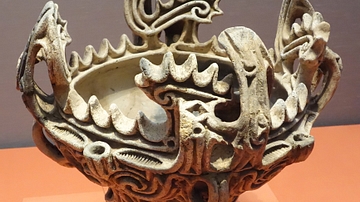
Jomon 'fire-flame' Vessel
A Jomon pottery vessel with the decorative style known as 'fire-flame'. Jomon Period, 3000-2000 BCE, Sasayama site, Niigata Prefecture. Japan. (Tokyo National Museum)
