
Search
Remove Ads
Advertisement
Search Results

Definition
Roman Coinage
Roman coins were first produced in the late 4th century BCE in Italy and continued to be minted for another eight centuries across the empire. Denominations and values more or less constantly changed but certain types such as the...

Definition
Roman Sculpture
Roman sculpture blended the idealised perfection of Classical Greek sculpture with a greater aspiration for realism. It also absorbed artistic preferences and styles from the East to create images in stone and bronze which rank...

Interview
Interview: Conquering the Ocean by Richard Hingley
In this interview, World History Encyclopedia sits down with author Richard Hingly to chat about his new book Conquering the Ocean: The Roman Invasion of Britain published by Oxford University Press...

Definition
Cheyenne
The Cheyenne are a North American Native nation, originally from the Great Lakes region, who migrated to modern-day Minnesota and then to areas in North Dakota and further southwest. They are associated with the Plains Indians culture...

Definition
Shapur I
Shapur I (r. 240-270 CE) is considered one of the greatest kings of the Sassanian Empire for expanding his realm, his policy of religious tolerance, building projects, and committing the Zoroastrian scriptures (Avesta) to writing. He...

Definition
Gallienus
Gallienus was Roman emperor from 253 to 268 CE. Publius Licinius Egnatius Gallienus, the eldest son of Emperor Valerian, was named co-emperor by his father in 253 CE. He was one of many who would claim the throne over the next two...
Article
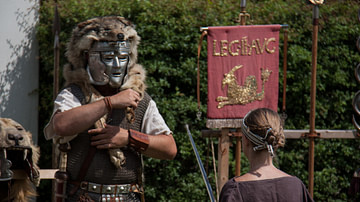
Legions of Britain
After the Roman emperor Claudius (r. 41-54 CE) successfully conquered Britain in 43 CE, four legions were left there to maintain the peace: XIV Gemina, II Augusta, IX Hispana, and XX Valeria Victrix. However, by the end of the...

Definition
Roman Government
Western Civilization is forever indebted to the people of ancient Greece and Rome. Among the numerous contributions these societies made are in the fields of art, literature and philosophy; however, perhaps their greatest gift...
Definition
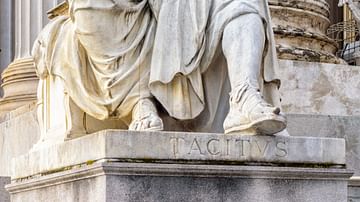
Tacitus
Publius Cornelius Tacitus (l. c. 56 - c. 118 CE) was a Roman historian, active throughout the reign of Trajan (r. 98-117 CE) and the early years of Hadrian (r. 117-138 CE). His best-known works are Histories and Annals, which cover the...

Definition
Hadrian
Hadrian (l. 78-138 CE) was emperor of Rome (r. 117-138 CE) and is recognized as the third of the Five Good Emperors (Nerva, Trajan, Hadrian, Antoninus Pius, and Marcus Aurelius) who ruled justly. His reign marked the height of the Roman...
