
Search
Remove Ads
Advertisement
Search Results

Definition
Sui Dynasty
The Sui Dynasty (581-618 CE) was a brief one with only two reigning emperors but it managed to unify China following the split of the Northern and Southern Dynasties period. As had happened previously in Chinese history, a short-lived...

Definition
Louis XIV of France - The Sun King
Louis XIV (1638-1715) reigned as King of France from 1643 to 1715. Known as Le Roi Soleil ('the Sun King'), he fervently believed in the concept of the 'divine right' of kings and is remembered for ruling as an absolute...
Definition
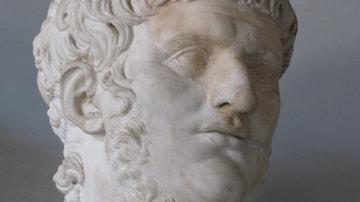
Nero - The Artist Emperor
Nero (37-68 CE) was the fifth Roman emperor, who reigned from 54 to 68 CE. The last emperor of the Julio-Claudian Dynasty, he came to power at the age of 16 with the help of his mother, Agrippina the Younger. Initially...

Definition
Albrecht Dürer
Albrecht Dürer (1471-1528) was a German Renaissance artist who is considered one of the greatest painters and engravers in history. A native of Nuremberg, Dürer was famous in his own lifetime at home and abroad for his oil paintings...
Definition
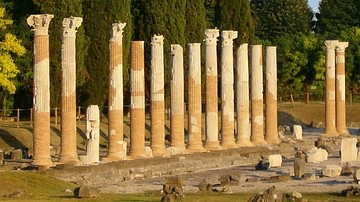
Aquileia
The ancient city of Aquileia was situated near the head of the Adriatic Sea west of the Roman province of Illyria. The strategic location of the city served a crucial role in the expansion of the Roman Republic by serving as a buffer...

Definition
Commodus
Commodus was Roman emperor from 180 to 192 CE. With the death of Roman Emperor Marcus Aurelius in March of 180 CE, the long reign of the five good emperors came to an end and with it so did the Pax Romana (the Roman Peace). Those emperors...

Definition
Byzantine Coinage
The coinage of the Byzantine Empire continued that of its more ancient predecessors and functioned as a convenient method of payment for goods and services, especially to soldiers and officials, and as a means for people to pay...

Definition
Christianity
Christianity is the world's largest religion, with 2.8 billion adherents. It is categorized as one of the three Abrahamic or monotheistic religions of the Western tradition along with Judaism and Islam. 'Christian' is derived from...

Definition
Byzantine Art
Byzantine art (4th - 15th century CE) is generally characterised by a move away from the naturalism of the Classical tradition towards the more abstract and universal, there is a definite preference for two-dimensional representations...

Definition
Justinian I
Justinian I reigned as emperor of the Byzantine Empire from 527 to 565 CE. Born around 482 CE in Tauresium, a village in Illyria, his uncle Emperor Justin I was an imperial bodyguard who reached the throne on the death of Anastasius...
