
Search
Remove Ads
Advertisement
Search Results
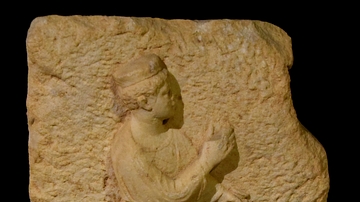
Image
Votive Stele from Sidon
This is a marble votive stele depicting a standing male looking to the right. He holds objects in both hands and wears a head cap. Roman Period, 5th to 4th century BCE. From Sidon, in modern-day Lebanon. (Museum of Archaeology...

Image
Buddhist Stele, Unified Silla Kingdom
A soapstone Buddhist stele from the Unified Silla Kingdom of Korea. From the Piamsa Temple. The scene depicts Buddha and disciples with apsaras looking on. Height: 40 cm, c. 673 CE. (National Museum of Korea...
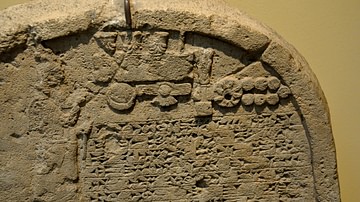
Image
Stele of King Sennacherib, a Close-up View
Limestone stele depicting Sennacherib praying in front of divine symbols and gods and recording the king's achievements and expansion of his royal capital, Nineveh. From Nineveh, Mesopotamia, modern-day northern...
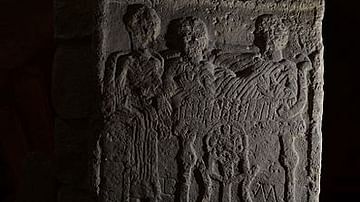
Image
Stele with Epitaph from Roman Dacia (Romania)
A Roman stele with an epitaph from the ancient town of Potaissa in Dacia (present-day Turda, Romania). It was made between c.151-270 CE. Height: 205 cm (80.7 in) Width: 77 cm (30.3 in) Depth: 17 cm...

Image
Sargon II Basalt Stele
This embossed human head stele is believed to be Sargon II (reigned 722-705 BCE) "who was one of the most important kings of the Neo-Assyrian Empire as founder of the Sargonid Dynasty." He is the father of Sennacherib (reigned...
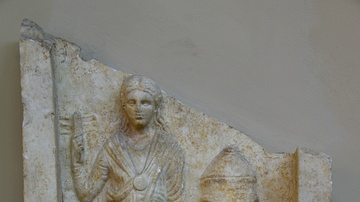
Image
Roman Stele with a Relief of Isis
This is a fragment of a votive marble stele showing the goddess Isis. Her right arm is raised and holds a sistrum. Roman Period, 2nd century CE. From Kanlıca, Istanbul, in modern-day Turkey. (Museum of Archaeology...
Image
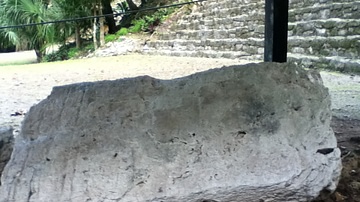
Maya Stele in Grand Plaza Chacchoben, Mexico
Weathered and broken stele in the Grand Plaza of the Maya city of Chacchoben, Mexico, c. 700 CE. It rests at the foot of the stairs leading up to the Gran Basamento plateau where religious rituals were held...
Image
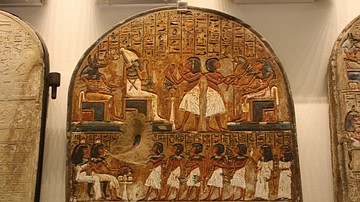
Minhotep & Nakhtmin Relief Stele
A sandstone relief stele depicting in the top panel Minhotep and his son Nakhtmin making offerings to Hathor, Anubis, and Osiris. The middle panel shows Minhotep and his wife Nefertari. The bottom panel shows Nakhtmin...
Image
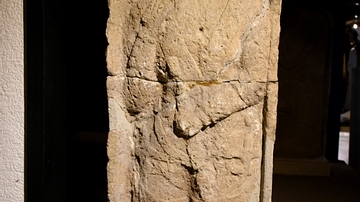
Parthian Sandstone Stele from Ashur
The man depicted on the stele was represented frontally. He raises his right arm while his left hand holds what appears to be a staff. A sword hangs down at his left waist. The divine emblems of Ishtar and Sin...

Image
Egyptian Funerary Stele from the First Intermediate Period
This is a door-shaped limestone stele of a priestess of the goddess Hathor. First Intermediate Period, 2134-2040 BCE. From Egypt. (Ancient Orient Museum, Istanbul, Turkey).
