
Search
Remove Ads
Advertisement
Search Results
Image
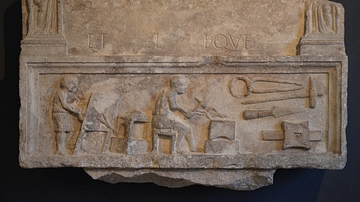
Funerary Stele of a Blacksmith
Limestone funerary stele of a blacksmith. The relief shows the inside of the blacksmith's workshop with forge tools and workshop products. An assistant is rekindling the fire in the forge using bellows. He is standing...
Image
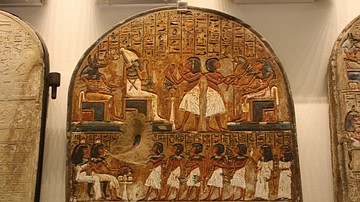
Minhotep & Nakhtmin Relief Stele
A sandstone relief stele depicting in the top panel Minhotep and his son Nakhtmin making offerings to Hathor, Anubis, and Osiris. The middle panel shows Minhotep and his wife Nefertari. The bottom panel shows Nakhtmin...
Image
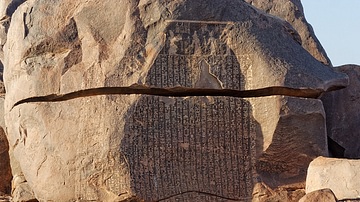
Famine Stele
The Famine Stele is an inscription from the Ptolemaic Dynasty of Egypt (332-30 BCE), which tells the story of how King Djoser saved his country.
Image
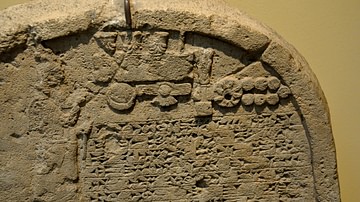
Stele of King Sennacherib, a Close-up View
Limestone stele depicting Sennacherib praying in front of divine symbols and gods and recording the king's achievements and expansion of his royal capital, Nineveh. From Nineveh, Mesopotamia, modern-day northern...
Image
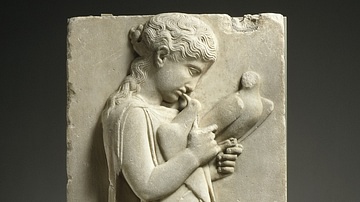
Stele of Little Girl with Doves
A marble stele depicting a young girl saying farewell to her pet doves as she gently holds them. Doves were popular animals in ancient Greece and frequently appeared in mythology and literature. Greek, Parian marble...
Image
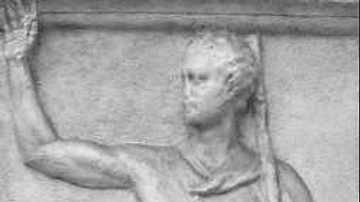
Stele of Polybius
Cast of a stele depicting the 2nd century BCE Greek historian Polybius.
Image
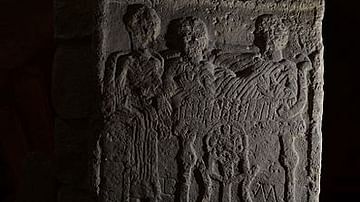
Stele with Epitaph from Roman Dacia (Romania)
A Roman stele with an epitaph from the ancient town of Potaissa in Dacia (present-day Turda, Romania). It was made between c.151-270 CE. Height: 205 cm (80.7 in) Width: 77 cm (30.3 in) Depth: 17 cm...
Image
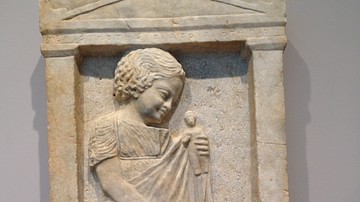
Grave Stele of a Young Girl, Melisto
Stele showing a girl holding a doll in one hand and a bird in the other, which she seems to be offering with a gentle smile to the small dog jumping up to greet her, c. 340 BCE.
Harvard Art Museums.

Image
Buddhist Stele, Unified Silla Kingdom
A soapstone Buddhist stele from the Unified Silla Kingdom of Korea. From the Piamsa Temple. The scene depicts Buddha and disciples with apsaras looking on. Height: 40 cm, c. 673 CE. (National Museum of Korea...
Image
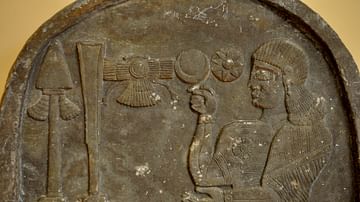
Stele of Bel-harran-beli-usur, close-up
Bel-harran-beli-usur was a high palace official (chamberlain) during the reign of the Assyrian kings Shalmaneser IV (782-773 BC) and Tigleth-Pileser III (744-727 BC). He built a city and a large temple to the...
