
Search
Remove Ads
Advertisement

 This answer was generated by
 Search Results
Image
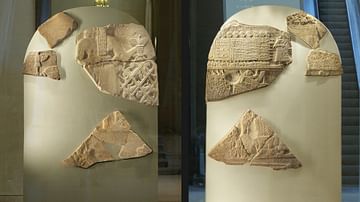
Stele of the Vultures
Stele of the Vultures fragments, dated to the Early Dynastic III Period (2600-2334 BCE), commemorating the victory of the city of Lagash over Umma.
Louvre, Paris.

Image
Battle Scene from Stele of the Vultures c. 2600 BCE
The Battle Scene from the Stele of the Vultures, created to commemorate the victory of Lagash over Umma c. 2600 BCE.
Louvre, Paris.
![Moabite Stone [Mesha Stele]](https://www.worldhistory.org/img/c/p/360x202/10037.jpg?v=1747932305)
Definition
Moabite Stone [Mesha Stele]
The Moabite Stone, otherwise known as the Mesha Stele, contains an ancient inscription by Mesha, King of Moab during the late 9th century BCE, elements of which match events in the Hebrew Bible. The inscription describes...
Article
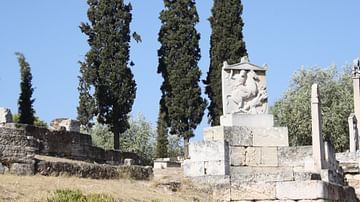
The Dexileos Stele: A Study of Aristocracy and Democracy in Greek Art
The Dexileos Stele assesses the way that Athenian political thought penetrated all levels of society, showing the conflict that the aristocratic classes were faced with in trying to find...

Article
Gobekli Tepe - the World's First Temple?
Located in modern Turkey, Göbekli Tepe is one of the most important archaeological sites in the world. The discovery of this stunning 10,000 year old site in the 1990s CE sent shock waves through the archaeological...

Article
The Banquet Stele of Ashurnasirpal II
When he came to the throne in 884 BCE, Ashurnasirpal II had to attend to revolts which broke out across the empire. He ruthlessly put down all rebellions, destroyed the rebel cities and, as a warning to others...
Definition
Mesopotamian Warfare - Early Development of Armed Conflict
Ancient Mesopotamian warfare progressed from companies of a city's militia in Sumer to the professional standing armies of Akkad, Babylon, Assyria, and Persia, and from conflicts over land or water...

Definition
The Great Sphinx of Giza
The Great Sphinx of Giza is the most instantly recognizable statue associated with ancient Egypt and among the most famous in the world. The sculpture, of a recumbent lion with the head of an Egyptian king, was carved out...

Definition
Gwanggaeto the Great
Gwanggaeto (Kwanggaeto), often referred to as Gwanggaeto the Great, was king of the Goguryeo (Koguryo) kingdom which ruled northern Korea during the Three Kingdoms period. Gwanggaeto reigned between 391 and 413 CE, and living...

Article
The Legend of Cutha - A How-To on the Proper Relationship with One's God
The Legend of Cutha (also known as the Cuthean Legend of Naram-Sin, Cutha Legend, and Kutha Legend) is a fictional work dated to the 17th century BCE belonging to the genre known as...
