
Search
Remove Ads
Advertisement
Search Results

Image
Funeral Stele of Artistion
Marble funeral stele depicting a hoplite soldier, signed by Aristokles (500 BCE), National Archaeological Museum, Athens.
Image
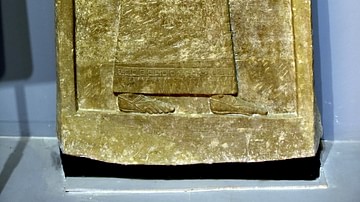
Stele of Adad-Nirari III
Limestone stele of the Assyrian king Adad-Nirari III (r. 810-783 BCE) from Tell al-Rimah, in modern-day Nineveh Governorate, Iraq. The king is praying before gods and goddesses symbols. The cuneiform inscriptions mention...
Image
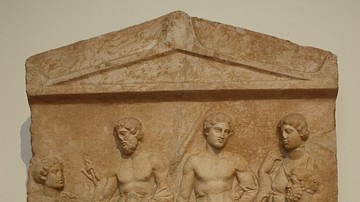
Boeotian Grave Stele
A Boeotian grave stele. 5th century BCE, Thespian marble. (National Archaeological Museum, Athens)
Image
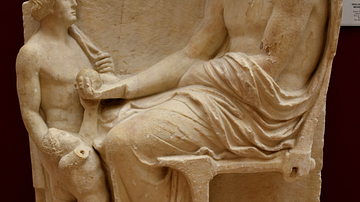
Funerary Stele from Amisus Showing a Farewell Scene
In this funerary stele, the deceased sits on a chair and appears to give a rounded object to a child (or maybe the reverse), who stands in front of him. Marble. Classical Period, near the end of the...
Image
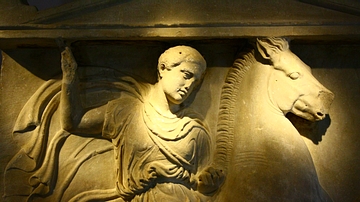
Dexileos Stele (detail)
Detail of the Dexileos Stele. Visible are the holes where metal attachments would have been placed. On his leg a sword; in his right hand a spear; in his left hand the horse's reigns; and on his head, most likely a wide-brimmed...

Image
The Seikilos Stele
The Seikilos Stele, Copenhagnen NM inv.14897. This grave stele preserves the oldest complete song that has survived to our times, and dates to around the 2nd century CE. Found in 1883 by Sir William Ramsay at Aydin (Tralleis...

Image
Akkadian Stele of Ilšu-rabi from Tell Abu Sheeja
The stele was found at Tell Abu Sheeja, north of modern-day Amarah city, Maysan Governorate, Iraq. The Old Akkadian cuneiform inscription on the left side of the viewer mentions the name of the city of...
Image
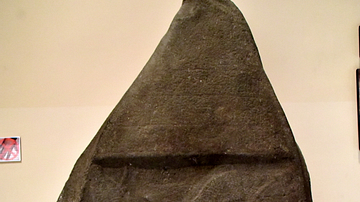
Al-Balu' Stele
Al-Balu's stele is a Moabite document. This stele found in Al-Balu'a, north of Kark, in 1930 CE contains an illegible hieroglyphic inscription. There are three figures depicted on the stele, which may represent a king and two deities...
Image
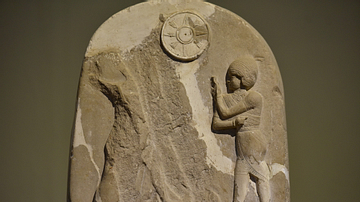
Stele of Dadusha at the Iraq Museum (detail)
This detail shows the upper register of the stele of Dadusha. The stele is an elongated stone monument which originally stood at the Temple of Adad at Eshnunna. The front side is carved with four registers...

Definition
Foundation Decree of Cyrene
The Foundation Decree of Cyrene (c. 322 BCE) is a covenant between the citizens of Cyrene in North Africa in the 4th century BCE and those of their mother-state of Thera granting any who wish to become Cyrenean citizens...
