
Search
Remove Ads
Advertisement
Search Results

Image
Stele of the Akkadian king Naram-Sin
According to the inscription on the diorite piece of stele, it belongs to King Naram-Sin. It was found in Pir Hüseyin, a village near Diyarbakır. As it shows the borders of the Akkadian State in the era of Naram-Sin...

Image
Victory Stele of Naram-Sin
Victory Stele of Naram-Sin, king of Akkad. c. 2250 BCE. Brought from Sippar to Susa in the 12th century BCE. Restored in 1992 CE. (Louvre Museum, Paris)
Image
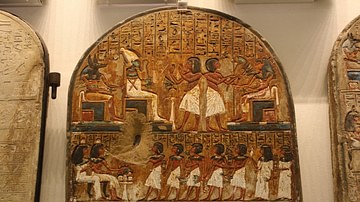
Minhotep & Nakhtmin Relief Stele
A sandstone relief stele depicting in the top panel Minhotep and his son Nakhtmin making offerings to Hathor, Anubis, and Osiris. The middle panel shows Minhotep and his wife Nefertari. The bottom panel shows Nakhtmin...
Image
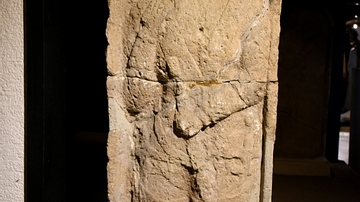
Parthian Sandstone Stele from Ashur
The man depicted on the stele was represented frontally. He raises his right arm while his left hand holds what appears to be a staff. A sword hangs down at his left waist. The divine emblems of Ishtar and Sin...

Image
Egyptian Funerary Stele from the First Intermediate Period
This is a door-shaped limestone stele of a priestess of the goddess Hathor. First Intermediate Period, 2134-2040 BCE. From Egypt. (Ancient Orient Museum, Istanbul, Turkey).

Image
Thebes Funerary Stele
A funerary stele from Thebes, Egypt. Plastered and painted wood. 7th-4th century BCE. (Archaeological Museum of Milan, Italy)

Image
Dexileos Stele
Dexileos Stele replica in situ, Dipylon Cemetery, Athens. (Original in the Kerameikos Museum, P 1130, c. 394 BCE)
Image
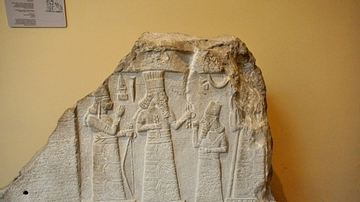
Shamsh-res-usur Stele
Shamsh-res-usur was a local governor of Mari and Suhi. The stele tells us that this governor reigned for 13 years. During this period, he re-built the city of Gabarri-Ibni, established irrigation canals, and encouraged the...

Image
Egyptian Funeral Stele
Plastered and painted funerary stele from the 7th-4th century BCE.
Egyptian Museum, Castello Sforzesco, Milan.
Image
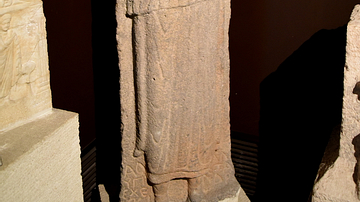
Funerary Stele of Errethas and Marthes
The inscription on this basalt funerary stele mentions the names of Errethas and Marthes. Roman Period, January 109 CE. From Damascus, in modern-day Syria. (Museum of Archaeology, Istanbul, Turkey).
