
Search
Did you mean: Olympia?
Remove Ads
Advertisement
Search Results

Definition
Lycurgus
Lycurgus is considered the semi-mythical founder of classical Sparta and responsible for all of the city-state’s laws as well as its military and political institutions. He became better known to generations of Spartans as the lawgiver. He...
Definition
Agrigento
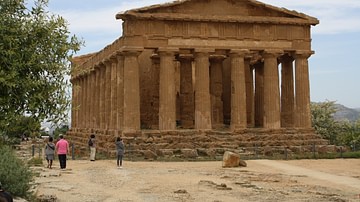
Agrigento (Greek: Akragas, Latin: Agrigentum) was a Greek-founded city-state located on the south coast of Sicily near the river Akragas (now S. Biagio) just 5 km from the sea. At its peak, the city may have had as many as 300,000 inhabitants...
Definition
Pelops
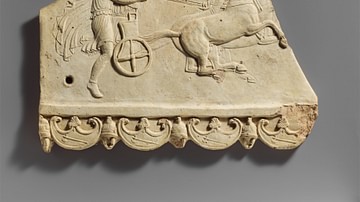
Pelops was a Greek hero and king of Pisa in Greek mythology. As the son of Tantalus, he was a member of the cursed House of Atreus, and was cruelly sacrificed by his father in a twisted way to test the gods – an act that backfired and led...
Definition
Callimachus of Cyrene
Callimachus of Cyrene (l. c. 310-c. 240 BCE) was a poet and scholar associated with the Library of Alexandria and best known for his Pinakes ("Tablets"), a bibliographic catalog of Greek literature, his poetry, and his literary aesthetic...

Definition
Gela
Gela (Greek: Ghéla), in southern Sicily, was a Greek colony founded c. 689 BCE and it remained an important cultural centre throughout antiquity. Prospering on trade and expanding its territory, the city-state founded Agrigento. In the 5th...

Article
Spartan Women
Spartan women had more rights and enjoyed greater autonomy than women in any other Greek city-state of the Classical Period (5th-4th centuries BCE). Women could inherit property, own land, make business transactions, and were better educated...

Article
Early Christianity
Emerging from a small sect of Judaism in the 1st century CE, early Christianity absorbed many of the shared religious, cultural, and intellectual traditions of the Greco-Roman world. In traditional histories of Western culture, the emergence...

Article
The Hindenburg Disaster - End of the Transatlantic Airships
The Hindenburg disaster occurred on 6 May 1937 when the German Zeppelin airship LZ 129 Hindenburg attempted to land at Lakehurst, New Jersey, but burst into flames. The airship's gas cells were filled with highly flammable hydrogen gas, and...

Article
A Visual Who's Who of Greek Mythology
Achilles The hero of the Trojan War, leader of the Myrmidons, slayer of Hector and Greece's greatest warrior, who sadly came unstuck when Paris sent a flying arrow guided by Apollo, which caught him in his only weak spot, his heel. Adonis...

Article
Alexander the Great as a God
The age-old concept of the “divine right of kings” allowed that a country's ruler received his or her power or authority from God. However, few, if any, were delusional enough to actually believe themselves to be a god. An exception to this...
