
Search
Did you mean: Olympia?
Remove Ads
Advertisement
Search Results
Article
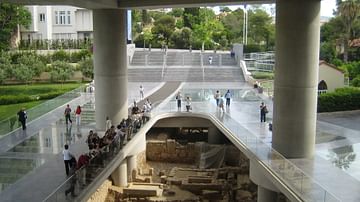
Overlooked Athens: 5 Ancient Sites
For centuries, the Parthenon has been Athens' biggest tourist magnet. Pausanias gushed over it in the 2nd century CE, Elgin coveted it, Byron mourned for it, and countless tour groups and camera-toting enthusiasts swarm over it today. But...

Definition
Gymnasium - The Ancient Greek Building for Sport & Study
The Gymnasium was a Greek building originally used for athletic activities but which came, over time, to be used also as a place of study and philosophical discussion. In the Hellenistic Period, gymnasia became highly standardized both in...

Collection
21 Famous Women of World History
This collection presents biographies of 21 famous women from world history but those included represent only a small fraction of the many women, from ancient times to the present, who have made a lasting impression on the people of their...

Video
Prize amphora showing a chariot race
Chariot-racing was the only Olympic sport in which women could take part, as owners of teams of horses. Kyniska, a princess of Sparta, was the first woman to win the Olympic crown in this sport. British Museum curator Judith Swaddling describes...

Video
Sprinter on a Vase from Rhodes and a Bronze Running Girl
The greatest Olympic runner of all was Leonidas of Rhodes who won all three running events at each of the four successive Olympiads between 164 and 152 BCE. Women competed in foot races at Olympia, but these were not part of the Olympic Games...

Article
Travel in the Ancient Greek World
Travel opportunities within the ancient Greek world largely depended on status and profession; nevertheless, a significant proportion of the population could, and did, travel across the Mediterranean to sell their wares, skills, go on religious...
Image
Greek Wrestlers
A relief from a funerary kouros base depicting two Greek wrestlers, one of the sports at such events as the Olympic Games at Olympia. c. 510 BCE. (National Archaeological Museum, Athens)

Image
Agias, Son of Aknonios
A votive marble offering in the style of Lysippos from the Daochos Monument at Delphi; over-life-size at 2m tall; Late Classical; c.336- 332 BCE. Agias was the grandfather of Daochos II, who dedicated the monument, and a highly successful...
Image
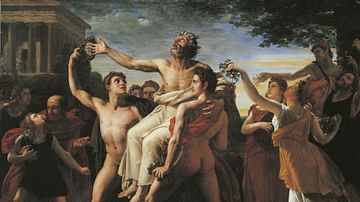
Diagoras of Rhodes
Diagoras is carried by his two sons after an Olympic victory, painting by Auguste Vinchon, 1814.
National School of Fine Arts (Beaux-Arts de Paris), Paris.

Video
Peloponnese, Greece: The Sanctuary of Olympia
For over a thousand years, the Sanctuary of Olympia was primarily a religious place and only open to people during the Olympic games, started here in 776 B.C. These games were held to honor the gods and to unify the Greeks, and the Sanctuary...
