
Search
Did you mean: Olympia?
Remove Ads
Advertisement
Search Results

Article
Female Gladiators In Ancient Rome
Female gladiators in ancient Rome – referred to by modern-day scholars as gladiatrix – may have been uncommon but they did exist. Evidence suggests that a number of women participated in the public games of Rome even though this practice...

Article
The Transatlantic Zeppelins - A Golden Age of Air Travel
Transatlantic Zeppelins carried passengers in relative luxury between Germany and New York or Rio de Janeiro during the 1920s and 1930s. The airships Graf Zeppelin and Hindenburg crossed the Atlantic in two or three days, faster than contemporary...

Article
Christian Antisemitism in the Middle Ages & during the Reformation
Antisemitism is a modern term that describes prejudice and hostility to Jews and Judaism. The origins of Christian antisemitism in the gospels are based on the story of a 1st-century itinerant Jewish preacher, Jesus of Nazareth, in the Roman...
Article
Greek World Heritage Sites
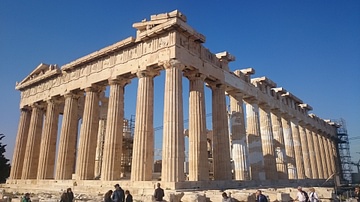
Greece, the 'cradle of western civilization', is home to a large number of spectacular sites from the ancient world, several of which have been placed on the UNESCO World Heritage List. These sites of great historical importance, interest...

Article
Pericles & the Restoration of the Athenian Agora
The agora of Athens developed from the 6th century BCE until it was destroyed in the Persian invasion of 480 BCE. Afterwards, the statesman Pericles (l. 495-429 BCE) used funds from the Delian League to restore it as the physical manifestation...

Article
The Delian League, Part 5: The Peace of Nicias, Quadruple Alliance, and Sicilian Expedition (421/0-413/2 BCE)
This text is part of an article series on the Delian League. The fifth phase of the Delian League begins with the Peace of Nicias – a settlement that settled nothing – and ends with the start of the Decelean War (also referred to as the...

Article
Museums in the Ancient Mediterranean
Museums have been around much longer than one might think, but in the ancient world, they were principally institutions of research and learning rather than places to display artworks and artefacts, even if they were often located in grand...
Article
The Life of Aristippus in Diogenes Laertius
Aristippus of Cyrene (l. c. 435-356 BCE) was a hedonistic Greek philosopher who taught that the meaning of life was pleasure and that the pursuit of pleasure, therefore, was the most noble path one could pursue. Along with Plato, Xenophon...

Interview
Interview: The Werewolf in the Ancient World by Daniel Ogden
In this interview, World History Encyclopedia is talking to author Daniel Ogden about his new book The Werewolf in the Ancient World. Daniel Ogden (Author): Thank you for inviting me! Kelly (WHE): Of course, we are very excited to have...

Interview
Interview with Dr. Rita Roussos
Join World History Encyclopedia as they chat with Dr. Rita Roussos. Dr. Roussos is a native Athenian who has taught archaeology and art history at the American University of Athens and is a trained archaeologist who has worked on sites like...
