
Search
Did you mean: Olympia?
Remove Ads
Advertisement
Search Results
Image
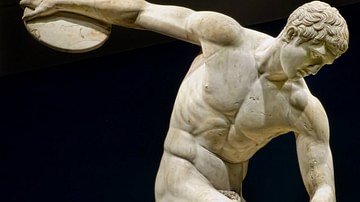
The Diskobolos (Discus Thrower)
The Diskobolos or Discus Thrower, 2nd century CE. Roman copy of a 450-440 BCE Greek bronze by Myron recovered from Emperor Hadrian's Villa in Tivoli, Italy. (British Museum, London)

Image
Starting Blocks, Olympia
The starting line of the stadium in Olympia (4th century BCE). Athletes had to place their toes in the front grooves on the block.

Image
Greek Chariot
A depiction of a chariot with charioteer on an attic black-figure kylix (510-500 BCE). Olympia Archaeological Museum.

Image
Greek Foot Race
Attic black-figure column crater depicting a foot race (510-500 BCE). Olympia Archaeological Museum.

Image
Greek Athletes
Greek athletes. From the base of a funerary kouros, later included in the Themistokleian Wall of Athens. 510-500 BCE. (National Archaeological Museum, Athens)
Image
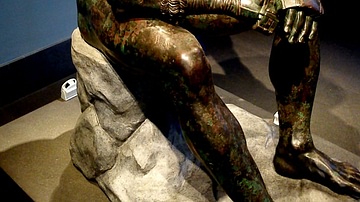
Boxer of Quirinal
The bronze Boxer of Quirinal, also known as the Terme Boxer, is a Hellenistic Greek sculpture dated around 330 BCE of a sitting boxer with Caestus, a type of leather hand-wrap, in the collection of the National Museum of Rome. It is one of...

Image
The Zanes, Olympia
Stone bases of the Zanes of Olympia. These statues of Zeus were funded from fines from offending athletes in the Games. (4th century BCE).
Image
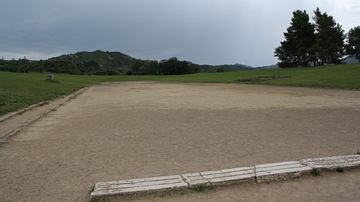
Stadium of Olympia
The stadium of Olympia (present form: 5th century BCE) with the starting line. The capacity at its maximum was 45,000.
Image
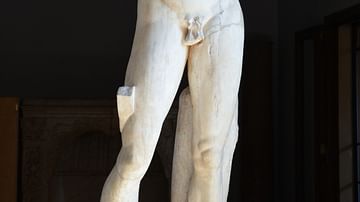
The Vatican Apoxyomenos (Scraper)
The Vatican Apoxyomenos (Scraper), Roman copy of the 1st century CE after a Greek bronze original by Lysippos ca. 330 BCE (Vatican Museums, Rome).
Image
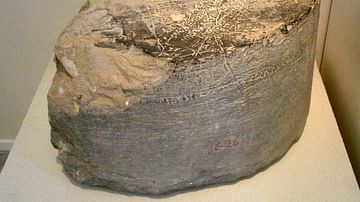
Cynisca's Inscription
Inscribed circular stone base of a four-horse chariot dedicated by Cynisca of Sparta, winner of chariot races, made by Apelles of Megara, from Olympia, after 390-380 BCE.
Archaeological Museum, Olympia.
