
Search
Did you mean: Marduk?
Remove Ads
Advertisement
Search Results
Article
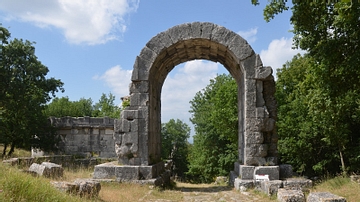
Visitor’s Guide to Carsulae (San Damiano)
Carsulae in Umbria, central Italy, was founded c. 300 BCE and only became a prosperous urban centre after it was connected by the Via Flaminia towards the end of the 3rd century BCE. It was granted the status...

Definition
Donatello
Donatello (c. 1386-1466 CE), full name Donato di Niccolo di Betto Bardi, was an Italian Renaissance artist best known for his sculptures such as the striking bronze figure of David now in the Bargello museum of his native Florence...
Article
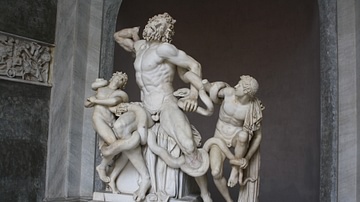
Laocoön: The Suffering of a Trojan Priest & Its Afterlife
The sculpture group of Laocoön and His Sons, on display in the Vatican since its rediscovery in 1506, depicts the suffering of the Trojan prince and priest Laocoön (brother of Anchises) and his...

Definition
Greek Architecture
Greek architecture is concerned with simplicity, proportion, perspective, and harmony in buildings. Greek architecture includes some of the finest and most distinctive buildings ever built. Examples of Greek architecture include...
Article
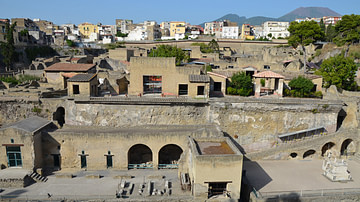
A Visitor's Guide to Herculaneum
In the first part of our new travel series devoted to the archaeological sites around the Bay of Naples, we shared some hints and tips as to how you can best prepare for your self-guided tour of Pompeii. In this second...

Definition
Michelangelo
Michelangelo (1475-1564 CE) was an Italian artist, architect and poet, who is considered one of the greatest and most influential of all Renaissance figures. His most celebrated works, from a breathtaking portfolio of masterpieces...

Definition
Parthenon
The magnificent temple on the Acropolis of Athens, known as the Parthenon, was built between 447 and 432 BCE in the Age of Pericles, and it was dedicated to the city's patron deity Athena Parthenos. The temple was constructed to house...

Definition
Cyclades
The Cyclades are a group of islands in the southern Aegean situated between the Greek mainland and Turkey. The name was coined in the Archaic period as the islands form an approximate circle (kyklos) around the central and most sacred...

Article
Winged Victory: the Nike of Samothrace
One of the most celebrated works of Hellenistic art is without doubt the Nike of Samothrace, on display at the Louvre since 1884 CE. The white Parian marble statue represents the personification of winged victory...

Article
Trade in the Byzantine Empire
Trade and commerce were essential components of the success and expansion of the Byzantine Empire. Trade was carried out by ship over vast distances, although for safety, most sailing vessels were restricted to the...
