
Search
Did you mean: Marduk?
Remove Ads
Advertisement
Search Results

Article
The Arch of Constantine, Rome
The Arch of Constantine I, erected in c. 315 CE, stands in Rome and commemorates Roman Emperor Constantine's victory over the Roman tyrant Maxentius on 28th October 312 CE at the battle of Milvian Bridge in Rome. It...

Article
The Great Palace of Constantinople
The Great Palace of Constantinople was the magnificent residence of Byzantine emperors and their court officials which included a golden throne room with wondrous mechanical devices, reception halls, chapels, treasury...

Article
Mandu - City of Joy
The city of Mandu is situated about 35 km from Dhar in the Madhya Pradesh region of northern-central India. Most of the city's monuments date to the 15th and 16th century CE. The city is located on a hill which rises 633 m...

Article
Visitor’s Guide to the Monuments of Hadrian’s Villa
Hadrian’s Villa near Tivoli, Italy, is an opulent, sprawling garden-villa covering some 120 hectares (296 acres). It was built by Emperor Hadrian (76-138 CE) between 125-134 CE for use as his country...

Definition
Artemis
Artemis was the Greek goddess of hunting, wild nature, and chastity. Daughter of Zeus and sister of Apollo, Artemis was a patron of girls and young women, and a protectress during childbirth. Artemis was widely worshipped but her most...

Definition
Roman Sculpture
Roman sculpture blended the idealised perfection of Classical Greek sculpture with a greater aspiration for realism. It also absorbed artistic preferences and styles from the East to create images in stone and bronze which rank...
Definition
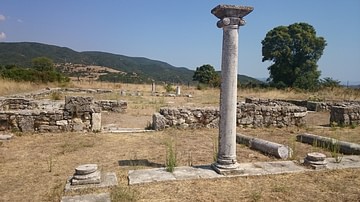
Amphipolis
Amphipolis, located on a plain in northern Macedonia near Mt. Pangaion and the river Strymon, was an Athenian colony founded c. 437 BCE on the older Thracian site of Ennea Hodoi. Thucydides relates that the Athenian general Hagnon...

Image
Dionysos, British Museum
Dionysos, god of wine, can be seen holding a bunch of grapes and crowned with a vine wreath. The statue stands 1.75 metres tall, is made of marble, and dates to the 2nd century CE. It is likely to be a Roman copy of a Greek...

Image
Cycladic Figurines
Marble figurines from Naxos in the Cyclades. The significance of the statues is not known for certain only that they were once painted and are generally found in a burial context across the Cyclades group. These examples date...
![Opus Sectile Flooring [Rosettes]](https://www.worldhistory.org/img/c/p/360x202/5534.jpg?v=1599422403)
Image
Opus Sectile Flooring [Rosettes]
A section of Roman opus sectile flooring. Marble, 1st century CE, urban quarter of Tarraco (Tarragona), Spain. (Archaeological Museum, Tarragona).
