
Search
Did you mean: Marduk?
Remove Ads
Advertisement
Search Results
Image
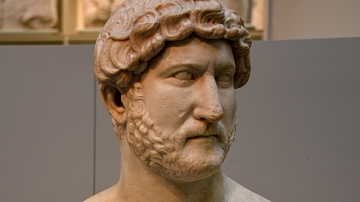
Marble Bust of Emperor Hadrian
Hadrian, like most Roman emperors, used statues to diffuse his image across the Roman World. Statues often showed the emperor as a general or priest. This bust shows Hadrian naked. This nakedness, originally a Greek...
Image
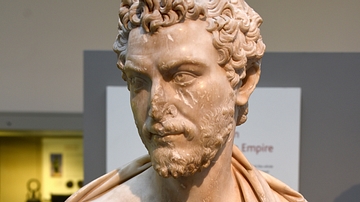
Marble Bust of a Young Greek Male
The man is dressed like Greeks of the Classical Period. His chest is bare and he has a heavy mantle draped over his shoulders This does not reflect the real fashion of his time, but is meant to lend him an air of...
Image
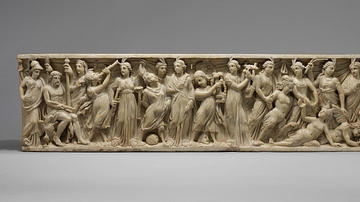
Marble Sarcophagus with the Contest between the Muses and the Sirens
"The deities Athena, Zeus, and Hera, assembled at the far left, preside over a musical contest between the Muses and Sirens. The Muses, associated with the highest intellectual and artistic...
Image
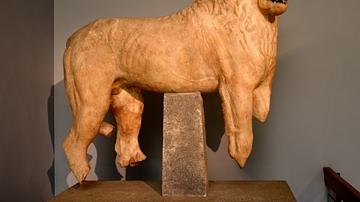
Marble Lion, Mausoleum at Halicarnassus
This is the most complete of the surviving lions from the Mausoleum at Halicarnassus, also known as the Tomb of Mausolus. The lions probably stood at the base of the stepped-pyramid roof, acting as both protective...

Image
Marble Bust of a Roman Woman
The woman may be a member of the imperial family. She is known from other portraits, but can not be individually identified. Roman, circa 160-170 CE. From the Pourtalès Collection. (The British Museum, London).
Image
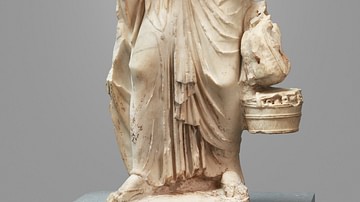
Marble Statue of an Old Woman
Roman sculpture of an elderly woman, c. 14-68 CE, a copy of a 2nd-century BCE Hellenistic original.
Metropolitan Museum of Art, New York.
Image
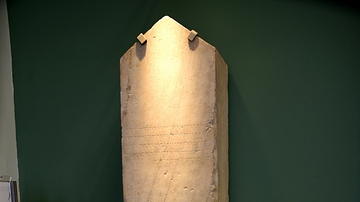
Marble Obelisk from Kition
The finely carved inscription on this obelisk dates to the 4th century BCE. The obelisk was set up in a cemetery at the Phoenician colony of Kition in Cyprus by a certain Arish in memory of his parent; his father Parz...
Image
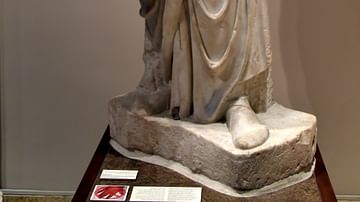
Marble Statue of a Man from Jerash
This man wears a "toga", a garment that was only worn by holders of the Roman citizenship. His shoes reflect his aristocratic social rank (equestrian). Behind him, was a basket of scrolls (rotuli); possibly, he...
Image
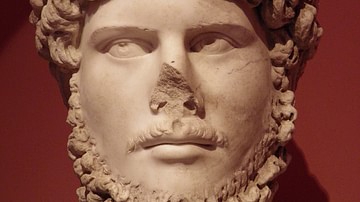
Marble Bust of Lucius Verus
Head of Lucius Verus (reign: 161 – 169 CE), from a colossal statue found in the north gallery of the palaestra of the South Baths in Perge, Turkey. (Antalya Museum)
Image
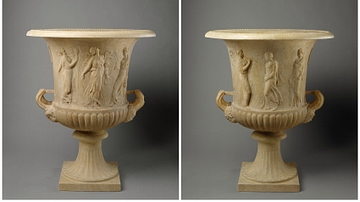
Marble calyx-krater with reliefs of maidens and dancing maenads
"The peristyle courtyards and gardens of the villas belonging to wealthy Romans were filled with fountains, sculpture, and monumental ornaments such as this vase. Many of these decorative...
