
Search
Did you mean: Marduk?
Remove Ads
Advertisement
Search Results
Image
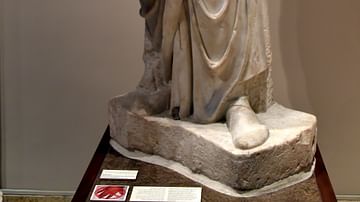
Marble Statue of a Man from Jerash
This man wears a "toga", a garment that was only worn by holders of the Roman citizenship. His shoes reflect his aristocratic social rank (equestrian). Behind him, was a basket of scrolls (rotuli); possibly, he...
Image
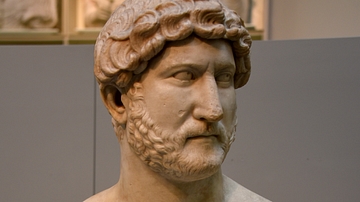
Marble Bust of Emperor Hadrian
Hadrian, like most Roman emperors, used statues to diffuse his image across the Roman World. Statues often showed the emperor as a general or priest. This bust shows Hadrian naked. This nakedness, originally a Greek...

Image
Marble Statue of Apollo from Samaria
Apollo was the god of music, light, truth, and healing in Graeco-Roman mythology, but this statue was found in a temple dedicated to "Kore", the goddess of the underworld and vegetation. The back of the statue...
Image
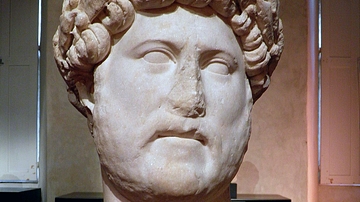
Marble Head of Hadrian With Laurel Wreath
Mixed portraiture type: Baiae & Imperatori 32. From c. 128 CE (Carthage) The photograph was taken during the exhibition “L’image et le pouvoir. Le siècle des Antonins” (Image and power. The age of the Antonines...

Image
Marble Bust of a Roman Woman
The woman may be a member of the imperial family. She is known from other portraits, but can not be individually identified. Roman, circa 160-170 CE. From the Pourtalès Collection. (The British Museum, London).
Image
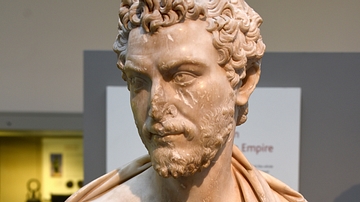
Marble Bust of a Young Greek Male
The man is dressed like Greeks of the Classical Period. His chest is bare and he has a heavy mantle draped over his shoulders This does not reflect the real fashion of his time, but is meant to lend him an air of...

Image
Marble Statuette of Bona Dea
A marble statuette of Bona Dea, the Roman goddess of chastity, fertility and healing.

Image
Marble Head of a Greek Philosopher
Marble head of a philosopher, early Roman copy (2nd century BCE) of a bronze Greek original from the 4th century BCE.
Archaeological Museum of Corfu.

Image
Marble Bust of Juba II
An early 1st Century marble bust of Juba II (r. 29 BCE - 23 CE), king of Mauretania and husband of Cleopatra Selene II (40 - 5 BCE). The bust is in the Glyptotek Museum in Copenhagen.
Image
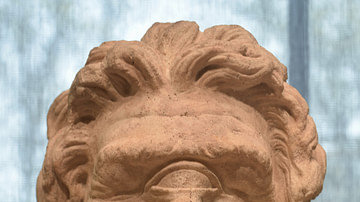
Marble Head of Polyphemus
A marble head of Polyphemus, perhaps part of a large-scale sculptural ensemble depicting the blinding of Polyphemos, similar to a group found in an imperial dining grotto at Sperlonga, south of Rome. Dated to about 150...
