
Search
Did you mean: Marduk?
Remove Ads
Advertisement
Search Results

Image
Roman Temple at Milreu, Portugal
Ruins of a water temple next to a villa, situated within the Roman ruins of Milreu, near Estói, southern Portugal. 4th century CE. The square cella of the temple ends in an apse to the south. The podium is decorated...

Image
Dying Niobid
A 5th century BCE marble sculpture of one of the daughters of Niobe, dying from an arrow wound in her back. According to the story from Greek mythology Niobe insulted the goddess Lato by thinking herself more worthy. Lato then had...
Image
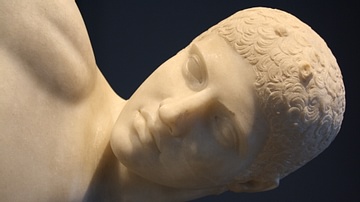
Head, Discobolus Lancellotti
The Discobolus Lancellotti in Parian marble. This is the most complete example from antiquity of the discobolus type statue, all of which were based on an original Greek bronze of c. 450 BCE by Myron. This example dates...

Image
Forum of Nicopolis ad Istrum
Forum of Nicopolis ad Istrum, photograph by Carole Raddato, 12 August, 2024. The forum of Nicopolis ad Istrum, Bulgaria. The paved square was surrounded by an Ionic colonnade and contained pedestals for marble and bronze...
Image
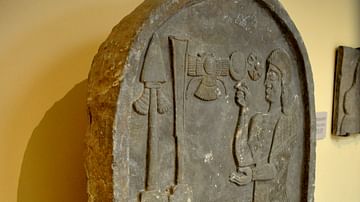
Stele of Bel-harran-beli-usur
Bel-harran-beli-usur was a high palace official (chamberlain) during the reign of the Assyrian kings Shalmaneser IV (782-773 BC) and Tigleth-Pileser III (744-727 BC). He built a city and a large temple to the west of...

Image
Mascot From Jemdet Nasr Period
This mascot is made of white marble and represents the "goddesses of the eye." Jemdet Nasr period, circa 3000 BCE, Mesopotamia, Iraq. (The Sulaimaniya Museum, Iraq).

Image
Aulos Player, Cyclades
A marble figurine from the Cycladic islands, 2800-2300 BCE, depicting a flute or aulos player. It is one of the earliest representations of a musician in sculpture from the Bronze Age Aegean. (National Archaeological Museum...

Image
The Varvakeion Athena
A marble copy of the Athena Parthenos which stood in the Parthenon. Also known as the Varvakeion Athena, it is the best preserved such copy. 3rd century CE. (National Archaeological Museum, Athens)
Image
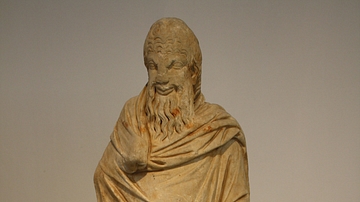
Pan Wearing an Animal Skin
A Parian marble statue of Pan. He holds a panpipe and wears an animal skin. From Sparta. 1st century CE copy of a 4th century BCE original. (National Archaeological Museum, Athens)
Image
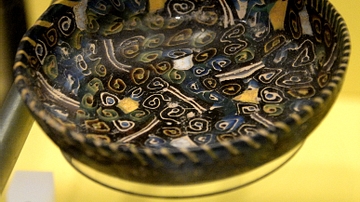
Luxury Glass Bowl
Ancient cast glass features a wide range of decoration, produced by fusing together different layers of colored glass. Mosaic patterns were created by cutting colored glass canes in cross-section, and marble glass was mould-blown...
