
Search
Did you mean: Marduk?
Remove Ads
Advertisement
Search Results

Image
Statue of Meleager
This much-amended statue of the mythical hunter Meleager goes back to a Greek bronze sculpture from around 340-330 BCE. It was the only sculptural decoration in a hall with galleries that overlooked the sea. Its privileged placement...

Image
Roman Sarcophagus (Detail)
A detail from a Roman sarcophagus in Procennesian marble depicting the Calydonian boar hunt from Greek mythology. The Greek hero Meleager attacks the boar with his spear while Artemis looks on. Provenance: Vicovaro, date...

Image
Artemis
A 2nd century CE Roman statue of the Greek goddess of hunting Artemis. The statue is a copy from a mid-4th century BCE Greek original. Weapons in bronze were commonly added to marble sculpture, such as the bow here. (The Vatican Museums...
Image
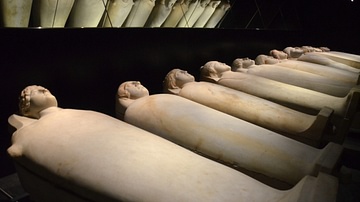
Anthropoid Sarcophagi from Sidon
Phoenician anthropoid sarcophagi from Sidon (modern-day Lebanon), beautifully carved in white marble from Greece. The sarcophagi consist of a hollowed lower box covered by a lid that slightly conveys the contours...
Image
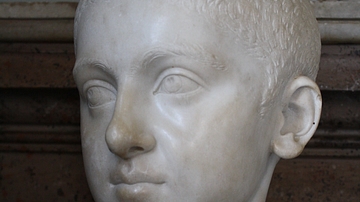
Severus Alexander Bust, Vatican Museums
A marble bust of Roman emperor Severus Alexander, r. 222-235 CE. (The Vatican Museums, Rome).

Image
Commodus As Hercules
A marble bust of Roman emperor Commodus as the hero of Greek mythology Hercules, c. 190-2 CE. (The Capitoline Museums, Rome)

Image
Bias of Priene
A marble herm bust of the Greek 4th century BCE orator Bias of Priene. Considered one of the seven sages his famous motto was 'Most men are bad'. Roman copy of the Hadrian period from a Greek original. (Vatican Museums, Rome)

Image
Mark Antony
A face re-creation of the roman general Mark Antony (l. 83-30 BCE), inspired by a fine grained yellow marble bust dating to the Flavian period (69-96 CE).

Image
Statuette of an Enthroned Cybele Flanked by Lions & Holding a Drum
Cybele, the Great Mother Goddess of Asia Minor, was holding a phiale (a shallow libation bowl) in her missing right hand. The lion and the drum, which was played during rites in Cybele's...
Image
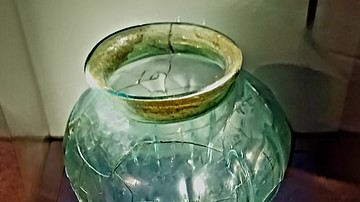
Roman Blue-Glass Cinerary Urn from Luguvalium
Roman blue-glass cinerary urn, from Luguvalium (Botchergate, Carlisle), 1st century CE. Carlisle Cathedral. Burning the body after death and keeping the bones and ashes in the cineraria (funerary urns...
