
Search
Did you mean: Marduk?
Remove Ads
Advertisement
Search Results
Image
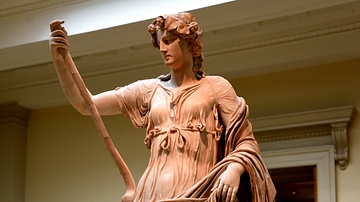
Thalia
In ancient mythology, Thalia was one of the 9 Muses. The Muses were female companions of the god Apollo and devoted to the arts and sciences. Although Thalia was associated with comedy, Roman poets described her as graceful and tender...

Image
Opus Sectile Flooring [Triangles]
A section of Roman opus sectile flooring. Marble, 2nd century CE, Saguntum (Sagunto), Spain (Archaological Museum, Segunto)

Image
Claudius Bust, Milan
Large grain marble head believed to be a local (Mediolanum) copy of an official portrait of Roman emperor Claudius (41-54 CE). (Archaeological Museum, Milan)
Image
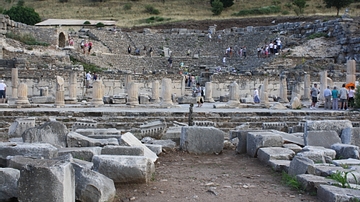
The Odeion, Ephesos
The Odeion (or small theate) of Ephesos was built in the second century CE and was used as both a meeting chamber and for entertainment. The marble seats gave a capacity of approximately 1,400.

Image
Nereid Fountain from Baiae
Marble fountain from Baiae. 1st century CE. A nereid (sea spirit) rides a pistrix (shark) - (the water would have originally flown from its mouth). Found in the sea off the spa resort of Baiae on the Bay of Naples, it...

Image
Relief of a Charioteer from Cyzicus
This chariot is driven by a pair of horses. The horses' mane and tail are plaited, and there are tassels around their neck (within the trappings). The chariot has 8-spoked wheels and the carriage is decorated with...

Image
Statue of Marsyas from Tarsos
Marsyas was the Phrygian satyr who was skinned alive when he challenged Apollo to a musical contest and lost. Marsyas was usually sculpted alone, as an isolated statue. However, this statue was found as part of a group...

Image
Statue of Emperor Nero
The emperor wears his military dress. The head, as well as the right upper limb and the distal part of the left arm were lost. Marble. Roman Imperial Period, first century CE. From Ömerbeyli (Germencik, Aydın), in modern-day...

Image
Relief of Nike from Balat
On this relief, the goddess Nike holds a date branch. This relief once decorated the entrance into the Balat Gate. Marble. Sixth century CE. From Balat, Istanbul, modern-day Turkey. (Museum of Archaeology, Istanbul, Turkey...

Image
Capital from Sarayburnu
This marble capital is decorated with masks. Late 5th to early 6th century CE. From structures within the walls of the Topkapi Palace, Sarayburnu, Istanbul, Turkey. (Museum of Archaeology, Istanbul, Turley).
