
Search
Did you mean: Muse?
Remove Ads
Advertisement
Search Results

Article
Ghosts in the Middle Ages
The medieval Church informed the people's religious imagination during the Middle Ages (c. 476-1500) and the world was therefore interpreted - even by heterodox Christians - through the Church's lens. Ghosts – referred to as revenants – were...

Article
Wall Reliefs: Ashurnasirpal II's War Scenes at the British Museum
The Mighty King 600 of their warriors I put to the sword and decapitated; 400 I took alive; 3,000 captives I brought forth; I took possession of the city for myself: the living soldiers, and heads to the city of Amidi the royal city, I sent...

Article
The Foundation of the Royal Society
The Royal Society was founded in 1662 to promote scientific research and increase our knowledge of the natural world. With royal patronage and a stellar membership of great minds, the society quickly gained international recognition for its...

Article
Chariots in Ancient Indian Warfare
The chariot was the elite arm of ancient Indian armies in the Vedic (1500 BCE – 1000 BCE) and Epic periods (described by the Ramayana and the Mahabharata, 1000-600 BCE) because of the advantages it conferred and the selection of plain ground...
Article
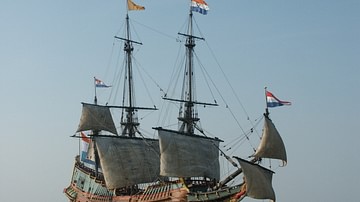
Wreck of the Batavia
The Batavia was a Dutch East India Company ship that foundered on the coral reefs of the Houtman Albrolhos Islands, 60 kilometres (37 mi) off the coast of Western Australia, just before dawn on 4 June 1629. It was the flagship of a fleet...

Article
Kingdom of Magadha: Wars and Warfare
In ancient India from the 6th century BCE onwards, the kingdom of Magadha (6th century BCE to 4th century BCE) made a mark for itself. Located in the eastern part of India in what is today the state of Bihar, it outshone other kingdoms and...

Article
The Coronation Ceremony of the British Monarchy
The coronation ceremony of the British monarchy as we know it today involves many elements that have been a part of the pageantry ever since the 11th century. Such features of the ceremony carried out in Westminster Abbey since 1066 have...
Article
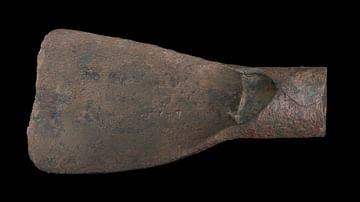
The Song of the Hoe
The Song of the Hoe is a Sumerian praise poem celebrating the hoe for its many uses and linking it to the creation of the world by the great god Enlil. As the economy of Mesopotamia was almost entirely based on agriculture, it is not surprising...

Image
Ashurnasirpal II Prays Before the Sacred Tree and the God Shamash
The Assyrian king appears to raise his right hand and point his right index finger in a gesture of worship. He holds a mace, the symbol of authority. The Sacred Tree (which is probably a palm tree) lies at the middle of the relief. The king...
Image
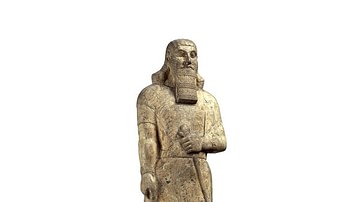
Statue of Ashurnasirpal II
Statue of Ashurnasirpal II from Nimrud (ancient Kalhu), modern-day northern Iraq, Neo-Assyrian Empire, 883-859 BCE. This statue of King Ashurnasirpal II (883-859 BCE) was placed in the Temple of Ishtar Sharrat-niphi. It was designed to...
