
Search
Did you mean: Muse?
Remove Ads
Advertisement
Search Results

Article
Food in the Roman World
The ancient Mediterranean diet revolved around four staples, which, even today, continue to dominate restaurant menus and kitchen tables: cereals, vegetables, olive oil and wine. Seafood, cheese, eggs, meat and many types of fruit were also...

Article
Twelve Gods of Persian Mythology
Ancient Persian Mythology is the term now referencing ancient Iranian religion prior to the rise of Zoroastrianism between c. 1500-1000 BCE. This was a polytheistic faith with a pantheon led by the supreme god Ahura Mazda (“Lord of Wisdom”...

Article
Weapons of the Conquistadors
The Iberian conquistadors ("conquerors") were the first military men to explore, attack, and conquer territories in the Americas and Asia that would then become a part of the Spanish or Portuguese Empire. Indigenous peoples could not match...

Article
The Marduk Prophecy - Travels of the Statue of a Babylonian God
The Marduk Prophecy is an Assyrian document dating to between 713 and 612 BCE found in a building known as The House of the Exorcist, adjacent to a temple in the city of Ashur. It relates the travels of the statue of the Babylonian god Marduk...

Article
Global Trade in the 13th Century
In the 13th century, astonishing quantities of spices and silk passed from the Far East to Europe. Exact amounts are not known, but spice popularity in both cuisine and medicine reached its historical peak during the Middle Ages in Europe...

Article
Colonel Blood & the Theft of the Crown Jewels
Colonel Thomas Blood, a known conspirator, made an infamous but unsuccessful attempt to steal the British Crown Jewels from the Tower of London in 1671. Disguised as a clergyman, Blood and his gang swiped the royal regalia from under the...

Article
The Dutch Discovery of Australia
17th-century Dutch East India Company (Vereenigde Oostindische Compagnie or VOC) navigators were the first Europeans to set foot on Australian soil. Although there is a strong theory that the Portuguese explorer, Cristóvão de Mendonça (1475-1532...

Article
The Mummy's Curse: Tutankhamun's Tomb & the Modern-Day Media
Howard Carter's 1922 CE discovery of the tomb of Tutankhamun was world-wide news but, following fast upon it, the story of the mummy's curse (also known as The Curse of the Pharaoh) became even more popular and continues to be in the present...
Article
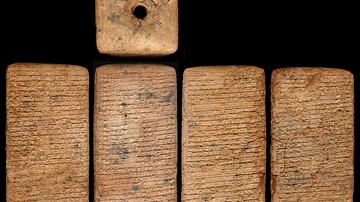
Kesh Temple Hymn
The Kesh Temple Hymn (c. 2600 BCE) is the oldest work of literature in the world, sometimes referenced as the oldest extant religious poem. It is a Sumerian praise song to the goddess Ninhursag and her temple in the city of Kesh, composed...

Article
Inanna and Ebih - A Poetic Narrative on Feminine Power
Inanna and Ebih is a Sumerian/Akkadian poem attributed to Enheduanna (circa 2300 BCE), daughter of Sargon of Akkad. The work's original title is Inninmehusa ("Goddess of the Fearsome Powers") and tells the story of the goddess Inanna's victory...
