
Search
Did you mean: Muse?
Remove Ads
Advertisement
Search Results

Definition
Nergal
Nergal (also known as Erra and Irra) is the Mesopotamian god of death, war, and destruction. He began as a regional, probably agricultural, god of the Babylonian city of Kutha in the Early Dynastic Period I (c. 2900-2800 BCE). As his temple...

Definition
Hanuman
Hanuman is one of several zoomorphic characters in Indian mythology, but is the only wholly animal figure who is revered as a god today. The mythic texts speak of him as a monkey child of the Wind God, as possessing enormous strength, keen...

Article
The Spice Trade & the Age of Exploration
One of the major motivating factors in the European Age of Exploration was the search for direct access to the highly lucrative Eastern spice trade. In the 15th century, spices came to Europe via the Middle East land and sea routes, and spices...

Article
Indian Ocean Trade before the European Conquest
Finding a maritime route to the East and gaining access to the lucrative spice trade stood at the root of the European Age of Exploration. However, when Vasco da Gama rounded the Cape of Good Hope and reached the Indian Ocean in 1493, he...

Article
Shulgi and Ninlil's Barge - A Poem Celebrating a Divine Event
Shulgi and Ninlil's Barge is a Sumerian poem dated to the reign of Shulgi of Ur (2094 - circa 2046 BCE) celebrating the caulking of the barge of the goddess Ninlil, consort of the sky god Enlil, and the banquet held in the couple's honor...

Article
The Death of Ur-Nammu - The Sumerian Vision of the Afterlife
The Death of Ur-Nammu is a Sumerian lament over the passing of the king Ur-Nammu (reign circa 2112-2094 BCE), founder of the Third Dynasty of Ur, who was killed in battle fighting the Gutians in 2094 BCE. The poem is frequently cited for...

Article
Ancient Persian Gods, Heroes, and Creatures - The Complete List
The term 'mythology' comes from the Greek mythos (story-of-the-people) and logos (word or speech), meaning the spoken story of a people. Every civilization of the ancient world developed a belief system, which is characterized as 'mythology'...

Article
Hymn to Nisaba
The Hymn to Nisaba (c. 3rd millennium BCE) is a poem praising Nisaba, the Sumerian goddess of writing and accounts who also served as scribe of the gods. The poem is officially dedicated to Enki, the god of wisdom (sometimes given as her...

Article
Eyes on the East: Chronicles of the Indian Ocean Spice Trade
As the 15th century ended, Europeans were still mostly in the dark about the Eastern world. Early travelers like Marco Polo had given the West tidbits of information, but these accounts were too highly colored and fragmentary to provide a...
Definition
Mahabharata
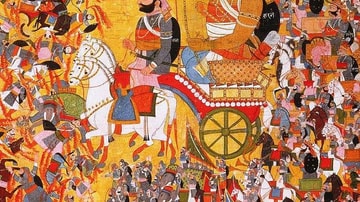
The Mahabharata is an ancient Indian epic where the main story revolves around two branches of a family - the Pandavas and Kauravas - who, in the Kurukshetra War, battle for the throne of Hastinapura. Interwoven into this narrative are several...
