
Search
Did you mean: Muse?
Remove Ads
Advertisement
Search Results
Image
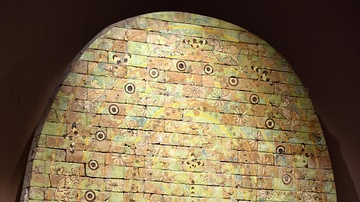
Glazed Wall Panel from Fort Shalmaneser
This large wall panel of vibrant glazed bricks was once placed above the entrance to a vast room (T3) next to Shalmaneser III's throne room at Fort Shalmaneser in Nimrud (in modern-day Nineveh Governorate, Iraq). The whole panel is composed...

Image
Bronze Figurine of a Female Athlete from the Roman Macedonia
Bronze figurine of a female athlete, found in the archaeological site of Samoil's Fortress in Ohrid, North Macedonia, 2nd to 1st centuries BCE. NI Institute for Protection of Monuments of Culture and Museum of Ohrid. Tsar Samoil's Fortress...
Image
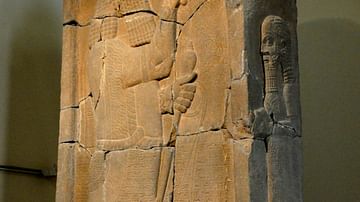
Sam'al Stele of King Esarhaddon
This commemorative basalt stele depicts the Assyrian king Esarhaddon worshiping gods and symbols of gods. The king's left hand holds a royal mace and two ropes. These ropes pass through the lips of two captives. The kneeling smaller figure...

Image
Yama
A painting of Yama, the Hindu god of the dead. c. 1820 CE. He rides his typical vehicle the buffalo and holds a mace and lasso, signifying his role as a catcher of souls.

Image
Surya Figure, Khajuraho
Surya, the Sun God. He holds lotuses, a mace, and a water pot. Not visible clearly in this picture is a also a time wheel that's in one of his bottom left hands. He wears a breastplate. His charioteer, Aruna, sits at the front. Khajuraho...

Image
A Wall Relief from Tiglath-Pileser III's Palace
A man holds a mace and a bow and a number of cows appear behind him. The name of the man is unknown. A fragment of a limestone wall relief from the palace of Tiglath-pileser III at Nimrud (ancient Kalhu; Biblical Calah). Neo-Assyrian era...

Image
King Tiglath-pileser III in a Ceremony
The Assyrian King Tiglath-pileser III (reigned 744-727 BCE) wears a ceremonial robe and holding a bow, once facing 2 high officials (no longer preserved but recorded in a drawing). Behind him, stands a beardless attendant holding a spear...
Image
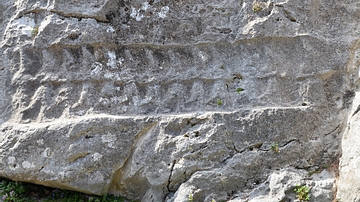
Rock Relief with Procession of Hittite Deities at Yazilikaya
Rock relief in Chamber A of the Yazilikaya Hittite Sanctuary (13th century BCE) near Hattusa depicting a procession of male deities. They all wear shoes curling up at the toe, and many are armed with either a sickle-shaped sword or a mace...
Image
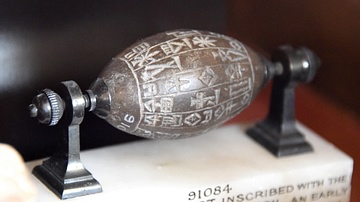
Macehead with the Name of Anum-mutabil
This oval stone mace-head was inscribed with the name of Anum-mutabil (formerly read as Ilum-muttabbil), governor of the Babylonian city Dur-ilu. The cuneiform inscription reads "Ilum-muttabbil, mighty man, favorite of god Istaran, beloved...
Image
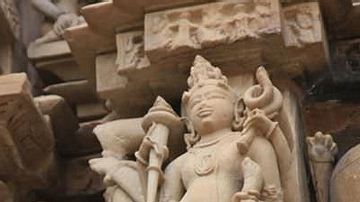
Kubera Figure, Khajuraho
Kuber, the money god. He holds a mace, a twisted weapon, and a mongoose. A money pot is on the floor behind him. Khajuraho, Madhya Pradesh, India, 11th CE.
