
Search
Did you mean: Muse?
Remove Ads
Advertisement
Search Results

Article
The Early History of Clove, Nutmeg, & Mace
The spices clove, nutmeg, and mace originated on only a handful of tiny islands in the Indonesian archipelago but came to have a dramatic, far-reaching impact on world trade. In antiquity, they became popular in the medicines of India and...
Image
Mace Surrounding Nutmeg Seed
Mace surrounding nutmeg seed.
Image
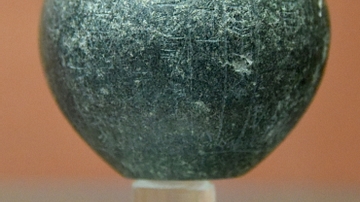
Votive Mace Head from Lagash
This mace head was inscribed with a cuneiform text. The text says that the mace is dedicated to the god Kindazi by the lady Ninkagina, both on her own behalf and that of Nam-mahani, who was a king of Lagash. The mace head itself has a name...
Image
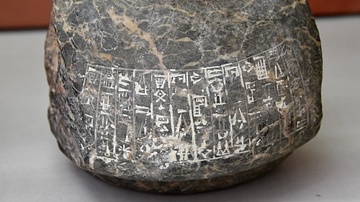
Votive Mace Head of Ur-Ningirsu II from Girsu
This grey stone mace head was inscribed with a cuneiform text. The text says that this mace head was dedicated to the god Ningirsu by Ur-Ningirsu II (son of Gudea, ruler of Lagash). From Girsu, Sothern Mesopotamia, modern-day Iraq. Circa...

Image
Votive Head Mace of La-arab, King of Gutium
This partially mutilated head mace was inscribed with an Akkadian cuneiform script, which mentions that this stone head mace is a votive offering dedicated by La-arab, king of Gutium. Although they left little evidence of their rule, it appears...

Image
Votive Mace Head of Shulgi
This marble votive mace head was inscribed with a cuneiform text. The text says that this mace head is a dedication on behalf of Shulgi, a king of Ur III, to the god Meslamtaea, or Nergal. From Mesopotamia, modern-day Iraq. Neo-Sumerian Period...
Image
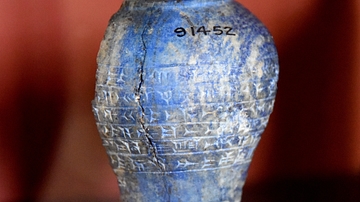
Portion of a Lapis Lazuli Head-Mace from the Temple of Ninurta
This fragment of a lapis lazuli Head-mace was inscribed with six lines of cuneiform inscriptions. The name of Ashurnasirpal II (reigned 884-859 BCE) was mentioned in this dedicatory text. Neo-Assyrian Period, 9th century BCE. From the Temple...
Image
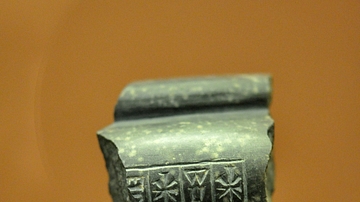
Votive Mace of Gudea
This votive stone mace head was polished and incised with four lines of cuneiform inscriptions. It was a dedication to the god Igalim by Gudea, ruler of Lagash. Lagash II period, c. 2150 BCE. From Lagash, Southern Mesopotamia, modern-day...
Image
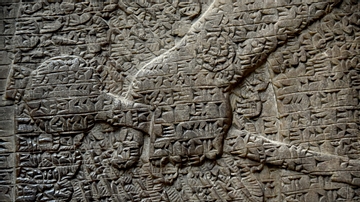
Apkallu Mace
Alabaster bas-relief detail showing the mace of an Apkallu. Neo-Assyrian Period, 865-860 BCE. Detail of Panel 26, Room B (Throne Room), the North-West Palace at Nimrud, modern-day Iraq. (The British Museum, London)
Image
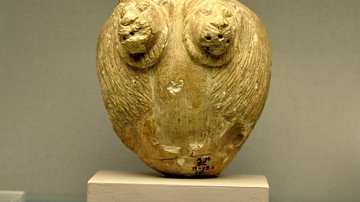
A Stone Mace Head with Lions
This is a symbolic weapon which was dedicated to a temple in order to receive gods' blessings. The lions' heads represent power and reflect the fact the donor was a royal person. Early dynastic period, 2500 BCE, from Sippar, Mesopotamia...
