
Search
Remove Ads
Advertisement
Search Results

Image Gallery
A Gallery of Assyrian Warfare
The Assyrian military was the most effective – and feared – fighting force in the Near East, especially during the time of the Neo-Assyrian Empire, 912-612 BCE, when their territory expanded across Mesopotamia, the...
Image
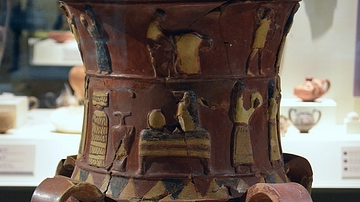
Early Hittite Vase
The İnandık vase, a Hittite four-handled large terracota vase with scenes in relief showing the stages of a sacred wedding ceremony in Hittite social life with musicians and dancers. The vase dates from the Old Hittite Kingdom...

Definition
Ugarit
Ugarit was an important sea port city in the Northern Levant. Though never a world power, Ugarit was a key economic center in the Ancient Near East, serving as a major trade center between Egypt and the major powers of Bronze Age Asia...
Image
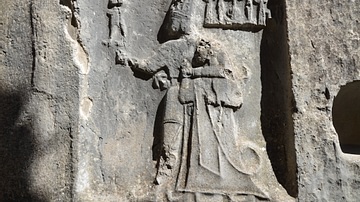
Hittite relief of the God Sharruma and King Tudhaliya
East wall of Chamber B of the Yazilikaya Hittite Rock Sanctuary near Hattusa (13th century BCE) depicting in a niche the God Sharruma (the Hurrian Mountain God and son of the Thunder God Teshub) embracing...
Image
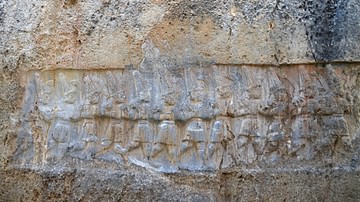
Twelve Gods of the Underworld, Yazilikaya Hittite Sanctuary
West wall of Chamber B of the Yazilikaya Hittite Sanctuary near Hattusa (13th century BCE) depicting the Twelve Gods of the Underworld. They wear short shirts, belts and shoes curling up at the...
Image
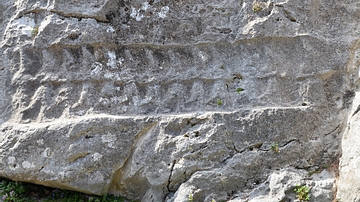
Rock Relief with Procession of Hittite Deities at Yazilikaya
Rock relief in Chamber A of the Yazilikaya Hittite Sanctuary (13th century BCE) near Hattusa depicting a procession of male deities. They all wear shoes curling up at the toe, and many are armed...
Image
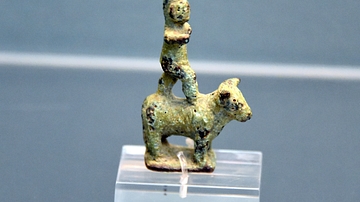
Figure of the Hittite God Teshub
The storm-god Teshub wears a tall headdress and stands on the back of a bull. From modern-day Turkey. Bronze figurine. Hittite period, 1600-1200 BCE. (The British Museum, London).
Image
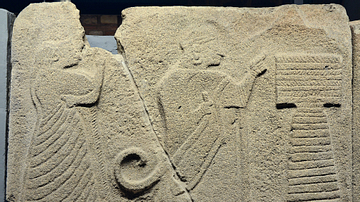
Hittite Orthostat with King and Queen
Hittite orthostat relief from Alacahöyük depicting a king and a queen in front of the altar. The King carries the kingdom sceptre (lituus) in his right hand and extends his left hand forward for worship. 14th...
Image
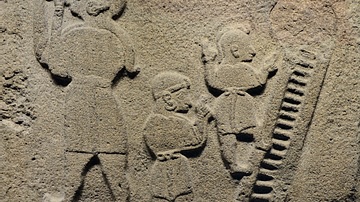
Hittite Orthostat with Acrobats
Hittite orthostate relief depicting a conjurer and acrobats. The performer on the left swallows a sword, the smaller acrobat goes up the stairs without holding on. 14th century BCE. Museum of Anatolian Civilizations...
Image
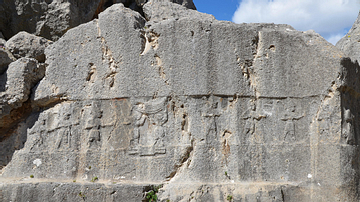
Hittite Rock Relief at Yazilikaya
Rock relief in Chamber A of the Yazilikaya Hittite Sanctuary (13th century BCE) depicting two bull-headed men standing between male gods on the hieroglyphic symbol of the earth, and supporting the sky.
