
Search
Remove Ads
Advertisement
Search Results
Image
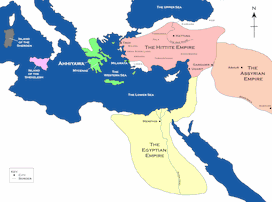
Map of the Hittite Empire and Surrounding States
A map of the Hittite Empire and surrounding states, including the Assyrian Empire, the Egyptian Empire, and Ahhiyawa. This map is an extract from the book Empires of Bronze by Gordon Doherty, republished...
Image
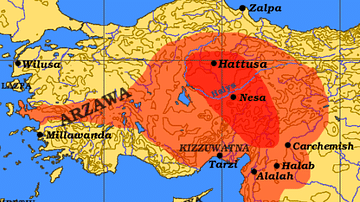
Hittite Empire c. 1300 BCE
The Hittite Empire at its maximum extension c. 1300 BCE (indicated in red. The Eyptian area of influence is indicated in green).

Image
Map of the Hittite Empire
A map showing the Hittite Empire in c. 1350-1300 BCE (dark green line) and at its maximum extent (light green area).

Image
The Sphinx Gate, Alacahöyük (Hittite settlement)
The Sphinx Gate at Alacahöyük (the site of a Neolithic and Hittite settlement in central Turkey) was built in the 14th century BCE. It was the south entrance of the city and was fortified with towers...
Image
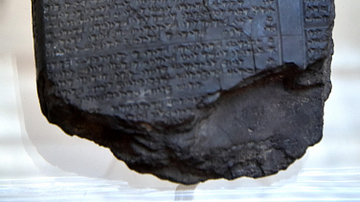
The Hittite Laws Tablet from Hattusa
This tablet's text is one of the latest versions of the Hittite laws text. In spite of some modifications (for example from the 16th century BCE versions), the articles of these two versions run parallel to each...

Image
Hittite Relief of Musicians
This basalt wall relief depicts four people playing on musical instruments. From Sam'al (modern-day Sinjerli, Gaziantep, Turkey). Late Hittite period, 8th century BCE. (Istanbul Archeological Museums/Ancient Orient Museum...
Image
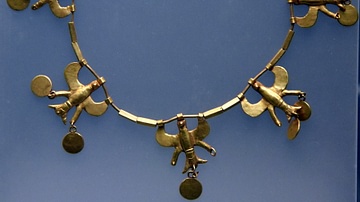
Hittite Gold Necklace
A gold necklace with flying eagles and pendant discs. From modern-day Turkey. Hittite, 1400-1200 BCE. (The British Museum, London).
Image
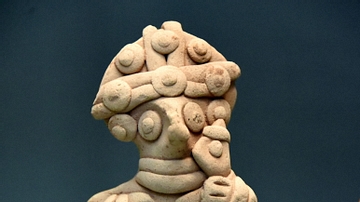
Hittite Figurine from Carchemish
This female figure wears an elaborate headgear and holds a baby in her left arm. She possibly represents a priestess or a deity. Fired clay. From House B at Carchemish, Southeastern Turkey. Neo-Hittite period, 7th...
Image
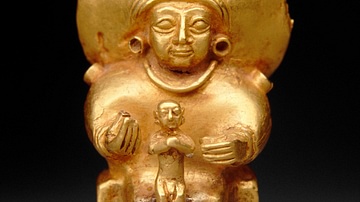
Seated Hittite Goddess with Child
Seated Hittite Goddess with Child, c. 14th-13th century BCE, from Central Anatolia, Metropolitan Museum of Art, New York.

Image
Winged Hittite Griffin-Demons
Relief orthostat (stone slab at the base of a wall) depicting two winged griffin demons, depicted as bird-headed with a human body. From Carchemish, Turkey. Dated to the Late Hittite period, 9-7th century BCE. Museum...
