
Search
Remove Ads
Advertisement
Search Results
Image
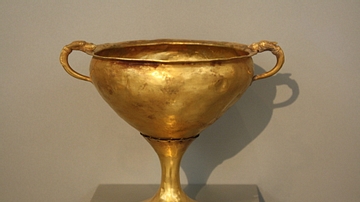
Mycenaean Gold Cup
A gold Mycenaean cup with handles ending in dog's heads. 15th century BCE from Grave circle A, Mycenae. (National Archaeological Museum, Athens)
Image
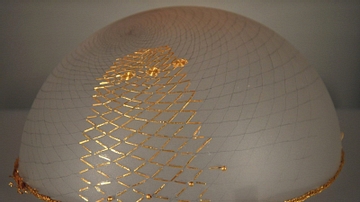
Roman Gold Hairnet
Hairnet made of finely woven gold wires, 1st century CE (Palazzo Massimo alle Terme, Rome)

Image
German Bunker, Gold Beach
A captured German bunker with 50-mm gun at Gold Beach, attacked during the D-Day Normandy landings of 6 June 1944. (Imperial War Museums)
Image
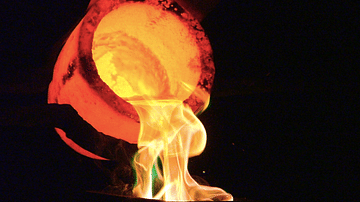
Liquid Gold
A photograph of liquid gold in a refinery.
Image
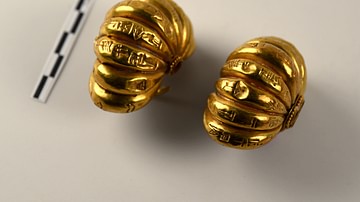
Mesopotamian Gold Earrings, Ur III
Both earrings are placed in a mirror-image position, with the lower surfaces facing each other. Each earring is composed of nine lunar-shaped segments forming a flattened half- ball. The cuneiform signs run vertically...
Image
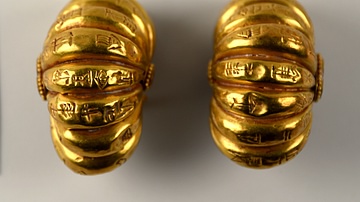
Cuneiform on Gold Earrings from Ur III
Both earrings are placed in a mirror-image position, with the lower surfaces facing each other. Each earring is composed of nine lunar-shaped segments forming a flattened half- ball. The cuneiform signs run vertically...

Image
Persian Gold Daric
Gold daric from Persia, kingdom of Achaemenids, 5th-4th century BCE. O: King with bow and quiver. R: Incuse oblong.
Image
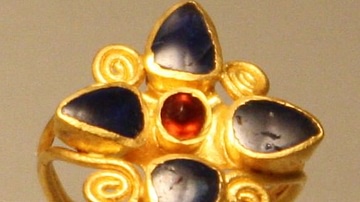
Roman Gold & Saphire Ring
Roman gold and saphire ring, second half of the 2nd century CE. The ring has a garnet centre stone. From an unidentified marble sarcophagus in Rome. (Palazzo Massimo, Rome)
Image
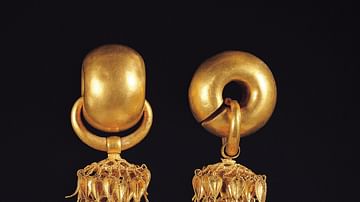
Silla Gold Earrings, National Treasure 52
5-6th century CE gold earrings from the Silla Kingdom (57 BCE - 668 CE) of south-eastern Korea. From a tomb in the Gyeongju area. National Treasure No. 52. (National Museum of Korea, Seoul, South Korea)

Image
Witwatersrand Gold
A chunk of quartz with gold from the Witwatersrand mines in South Africa.
Carnegie Museum of Natural History, Pittsburgh, Pennsylvania, USA.
