
Search
Remove Ads
Advertisement
Search Results
Image
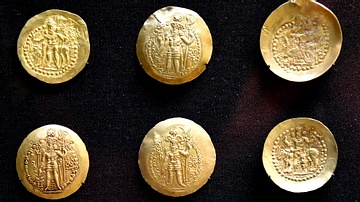
Gold Coins
Gold coins of the Sassanian, Kushanshah, and Kidarite Dynasties. 309-380 CE. From the Burnes, Cunningham, Hay, Parkes Weber, and Prinsep Collections. The British Museum, London.

Image
Gold & Glass Paste Earrings, Herakleia
Gold and glass paste earrings. Acropolis of Herakleia, southern Italy. 1st century BCE. (Archaeological Museum of Siritide, Policoro, Italy)

Image
Mycenaean Gold Necklace, Dendra
A Mycenaean gold necklace from Dendra, 15-14th centuries BCE. (National Archaeological Museum, Athens)

Image
Bronze & Gold Mycenaean Sword
A bronze Mycenaean sword with a gold handle inlaid with lapis lazuli, from Mycenae, Grave IV, Grave Circle A, 16th century BCE.
National Archaeological Museum, Athens.

Image
Quimbaya Gold Necklace
Gold lends itself to the development of decorative techniques. Pre-Columbian pieces from South America were cast and decorated with twisted wire. From the Quimbaya civilization, Colombia, 11th to 16th century CE. (National...
Image
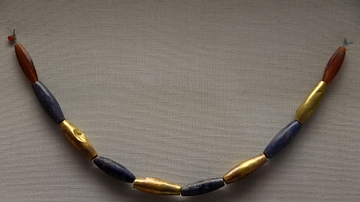
Puabi's Belt of Gold, Lapis Lazuli, and Carnelian Beads
This is a group of barrel-shaped beads of bitumen overlaid with four gold, four lapis lazuli, and two faceted cornelian beads. This jewellery was found by Puabi's thighs inside her grave, which...
Image
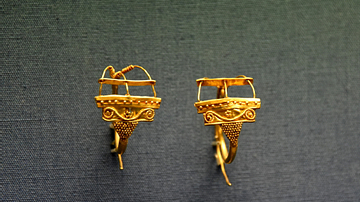
Gold Earrings from Bubastis
A pair of gold earrings. Said to be from Bubastis, in modern-day Egypt. Roman period, 1st to 2nd century CE. (The British Museum, London).
Image
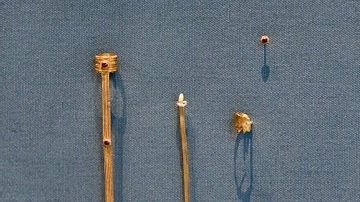
Gold Mounts from Sutton Hoo
These enigmatic mounts may have been emblems of office. Rivets and rivet-holes show that some were attached to other objects, perhaps bone or ivory rods that decayed in the ground. The most elaborate mount comprises a...
Image
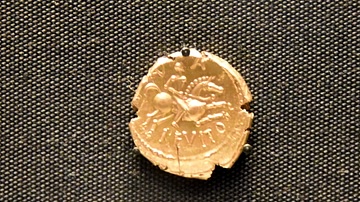
Gold Coin Naming a New King from Britian
This coin offers the first evidence for the existence of a local king called "Anarevito". He is not known either from other coin finds or Roman historical accounts. Coin inscriptions often provide the only...
Image
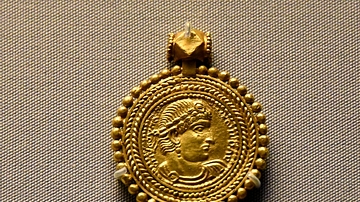
Gold Pendant from India/Pakistan
One side (reverse) of this elaborate gold pendant has designs based on coins of the Kushan rulers Kanishka I (100-126 CE) or Huvishka (126-163 CE); it shows an image of the goddess of wealth. On the other side (obverse...
