
Search
Remove Ads
Advertisement
Search Results
Definition
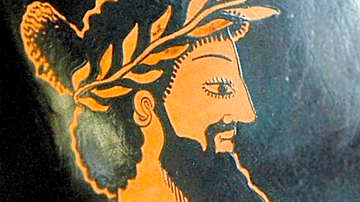
Croesus
Croesus (r. 560-546 BCE) was the King of Lydia, a region in western Asia Minor (modern-day Turkey) and was so wealthy that the expression "as rich as Croesus" originates in reference to him. Best known for his wealth, he is also famous...

Definition
Muisca Civilization
The Muisca (or Chibcha) civilization flourished in ancient Colombia between 600 and 1600 CE. Their territory encompassed what is now Bogotá and its environs and they have gained lasting fame as the origin of the El Dorado legend...

Image
Gold Pommel from Ur
This is a gold pommel from the hilt of a dagger. Many rivet holes can be seen. Early Dynastic Period, circa 2600 BCE. From the Royal Cemetery at Ur, Southern Mesopotamia, modern-day Iraq. Part of objects allotted to the British...

Image
Gold Phiale from the Panagyurishte Treasure
Gold phiale (shallow bowl) from the Panagyurishte treasure, early 3rd century BCE. National Historical Museum - Sofia/Plovdiv Archaeological Museum Photography: Oleg Konstantinov, Plovdiv Regional Historical...

Image
Gold Bezel Ring, Herakleia
Gold ring with carved red bezel. Tomb 1251, western necropolis, Herakleia, southern Italy. 1st century BCE. (Archaeological Museum of Siritide, Policoro, Italy)

Image
Gold Horn from Tell Al-Ubaid
This horn is filled with bitumen and would originally have been attached to a bull's head. On the Temple's facade, there was probably extensive use of gold, bu this is the only piece to survive. Early Dynastic Period...

Image
Gold Death Mask, Mycenae
Beaten gold death mask from Grave Circle A, Mycenae, 16th century BCE. (National Archaeological Museum, Athens)
Image
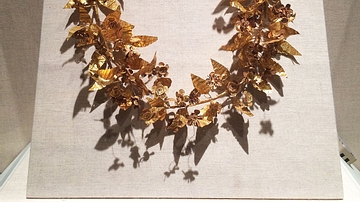
Ptolemaic Gold Wreath
Wreaths like this one formed to resemble flowers and leaves were used to crown athletic victors throughout the ancient Greek world. The Egyptian-born Greek writer Athenaeus of Nitocric (c. late 2nd-3rd century CE) tells of...

Image
Quimbaya Gold Necklace
Gold lends itself to the development of decorative techniques. Pre-Columbian pieces from South America were cast and decorated with twisted wire. From the Quimbaya civilization, Colombia, 11th to 16th century CE. (National...
Image
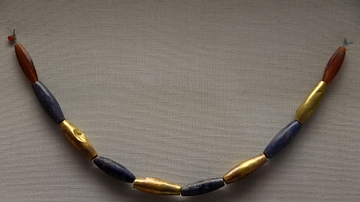
Puabi's Belt of Gold, Lapis Lazuli, and Carnelian Beads
This is a group of barrel-shaped beads of bitumen overlaid with four gold, four lapis lazuli, and two faceted cornelian beads. This jewellery was found by Puabi's thighs inside her grave, which...
