
Search
Remove Ads
Advertisement
Search Results
Image
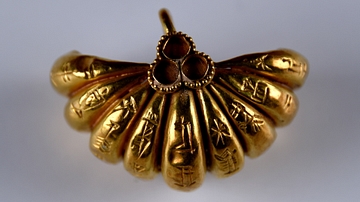
Cuneiform, Gold Earring from Ur III
This is the upper surface of the earring. Note how the cuneiform signs were carved and distributed and their distance from the center. The cuneiform text is read vertically, from the upper surface downwards on...

Image
Mycenaean Gold Jewellery Pieces
Strings of gold beads in the form of rosettes, papyrus and lillies from Mycenae area (14th century BCE). Nafplio Archaeological Museum.
Image
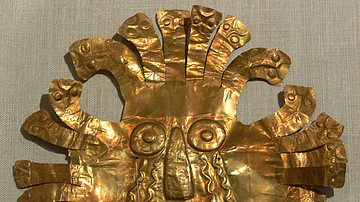
Nazca Gold Mask
A beaten gold mask from the Nazca civilization of Peru, 200 BCE-500 CE. 18.4 x 20.5 cm. The mask may represent a shaman in transformational pose, a common motif in Nazca art. An alternative interpretation is that it represents...
Image
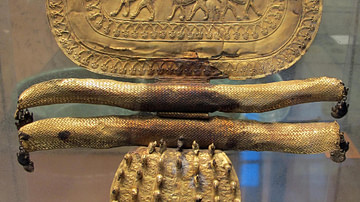
Etruscan Gold Fibula, Cerveteri
A gold fibula decorated with five lions (upper portion) and 50 ducks (lower portion) from the Etruscan Regoliini-Galassi Tomb at Cerveteri. 7th century BCE. (Museo Gregoriano Etrusco, Vatican Museums, Rome)
Image
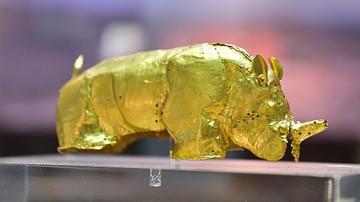
Gold Rhinoceros, Mapungubwe
A gold rhinoceros from a burial site at Mapungubwe, South Africa. 11-14th century CE. (University of Pretoria Museums, South Africa)

Image
Gold Stemmed Cup, Mycenae
A gold stemmed cup from Mycenae, often called the 'Cup of Nestor' following Homer's description. A dove rests on the top of each handle. 16th century BCE, Grave IV, Grave Circle A, Mycenae. (National Archaeological Museum...
Image
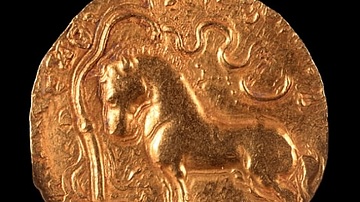
Gold Coins - Gupta Period
Gold coins issued by Samudragupta (circa 335 – 375 CE).
Image
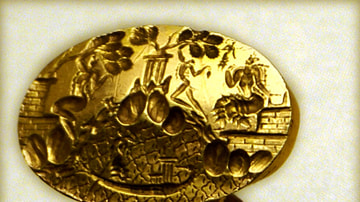
Minoan Gold Ring
An engraved gold ring from the Minoan civilization on Crete, 15-14th century BCE. The ring probably originates from Knossos and depicts the epiphany of a goddess: seated in a shrine, floating in the air and standing in a boat...

Image
Apollo, Macedonian Gold Stater
Macedonian gold stater, 359-336 BCE.
Obverse: Apollo
Reverse: Charioteer
Alpha Bank Numismatics Collection, Kerkyra, Corfu.
Image
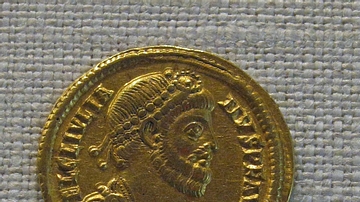
Gold Solidus of Antioch
A gold solidus from Antioch depicting Emperor Julian, 361-363 CE. (Metropolitan Museum of Art, New York).
