
Search
Remove Ads
Advertisement
Search Results

Definition
Suleiman the Magnificent
Suleiman the Magnificent (aka Süleyman I or Suleiman I, r. 1520-1566) was the tenth and longest-reigning sultan of the Ottoman Empire. Hailed as a skilled military commander, a just ruler, and a divinely anointed monarch...

Definition
Inanna - The Most Popular Goddess of Ancient Mesopotamia
Inanna is the ancient Sumerian goddess of love, sensuality, fertility, procreation, and also of war. She later became identified by the Akkadians and Assyrians as the goddess Ishtar, and further...

Definition
The Constantinian Excerpts - The 10th Century Byzantine Encyclopedia
The Constantinian Excerpts, or Excerpta Constantiniana is the conventional name given to the mid-10th Century Byzantine palace encyclopedia commissioned by the scholar emperor Constantine...

Definition
Enlil - Mesopotamian Keeper of the Tablets of Destiny
Enlil (also known as Ellil and Nunamnir) was the Sumerian god of the air in the Mesopotamian pantheon, but he was more powerful than any other elemental deity and eventually was worshiped as King of...

Definition
Yama
Yama is the Hindu god of death, king of ancestors, and final judge on the destination of souls. He is also known as the 'Restrainer', Pretaraja or 'King of Ghosts', Dharmaraja or 'King of Justice', and as Daksinasapati is considered the...

Definition
Providence Colony
Providence Colony (also known as Providence Plantation, modern-day Providence, Rhode Island, USA) was a settlement established in 1636 CE by the Puritan separatist theologian and pastor Roger Williams (l. 1603-1683 CE) after...

Definition
Ull
Ull (also known as Ullr), with his bow and skis, is such an elusive presence in Norse mythology that no conclusive remarks can be made about him. The 13th-century Icelandic author Snorri describes him only briefly in his Prose Edda, and...
Definition
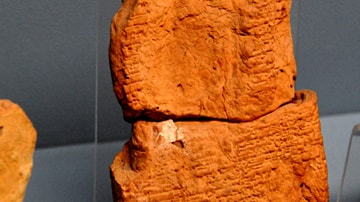
Code of Ur-Nammu - The Oldest Law Code in the World
The Code of Ur-Nammu (circa 2100-2050 BCE) is the oldest extant law code in the world. It was written by the Sumerian king Ur-Nammu (reign circa 2112-2094 BCE) or his son Shulgi of Ur (reign 2094 to...

Definition
Mesopotamia - The Beginning of Beginnings
Mesopotamia (from the Greek, meaning "between two rivers") was an ancient region located in the Near East (Middle East) bounded in the northeast by the Zagros Mountains and in the southeast by the Arabian Plateau...

Definition
Book of Amos
The Book of Amos is a prophetic book of the Hebrew Bible largely dating to the 8th century BCE and considered to be scripture by modern-day Jews and Christians. The work chronicles the visions that the ancient author of this book...
