
Search
Remove Ads
Advertisement
Search Results

Article
The Lamentations of Isis and Nephthys
The Lamentations of Isis and Nephthys is an ancient Egyptian text in which the two goddess-sisters call the soul of the god Osiris to rejoin the living. The poem takes the form of a call-and-response liturgy and...

Article
A Ghost Story of Ancient Egypt
The best-known ghost story from ancient Egypt is known, simply, as A Ghost Story but sometimes referenced as Khonsemhab and the Ghost. The story dates from the late New Kingdom of Egypt (c. 1570 - c.1069 BCE) and specifically...

Article
Clergy, Priests & Priestesses in Ancient Egypt
The ancient Egyptians understood that their gods had prevailed over the forces of chaos through the creation of the world and relied upon humanity's help to maintain it. The people of Mesopotamia held this...

Article
Siege of Khartoum - Last Stand of General Gordon
The siege of Khartoum from March 1884 to January 1885 was the most dramatic episode of the Mahdist War (1881-99) in Sudan when an army led by the inspirational Muslim leader, Muhammad Ahmad, the self-proclaimed...

Article
Pirates of the Mediterranean
The pirates of the ancient Mediterranean were not, for the most part, the outsiders who knew no country's allegiance and were the enemies of civilization as they are frequently depicted in novels and other media. They...

Definition
Abu Bakr
Abu Bakr (l. 573-634 CE, r. 632-634 CE) was an early convert of Islam; he was a close friend and confidant of the Islamic Prophet Muhammad, and became the first caliph of the Islamic empire – a successor to Muhammad's temporal position...

Definition
Judas Iscariot
Judas Iscariot was one of the original disciples of Jesus of Nazareth (d. c. 30 CE), one of the twelve apostles. For handing Jesus over to the authorities, as described in the gospels, he has become the epitome of the act of betrayal...

Definition
Vardhamana
Vardhamana (l. c. 599-527 BCE), better known as Mahavira (“Great Hero”) is the sage credited with founding of the nontheistic religion of Jainism, a belief system established in the 6th and 5th centuries BCE in India, which provided...

Definition
Sima Qian
Sima Qian (l. 145/135-86 BCE) was a court scribe, astrologer, and historian of the Han Dynasty (202 BCE - 220 CE) of ancient China, famous for his historical work Records of the Grand Historian for which he is remembered as the Father...
Definition
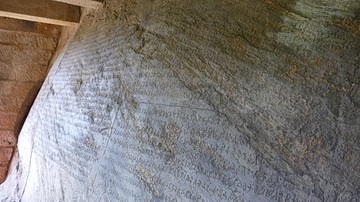
The Edicts of Ashoka the Great
The Edicts of Ashoka are 33 inscriptions engraved on pillars, large stones, and cave walls by Ashoka the Great (r. 268-232 BCE), the third king of the Mauryan Empire (322-185 BCE) of India. One set, the so-called Major...
