
Search
Remove Ads
Advertisement
Search Results

Image
Egyptian Stela of Horemheb
Only this fragment from the top of a round topped limestone stela has survived. There are 3 columns of hieroglyphic inscriptions; these state that the stela was "made by the guardian of king's provisions of the Lord of...
Image
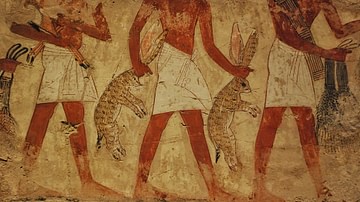
Egyptian Desert Hare Hunting
An Egyptian servant is carrying two desert hares as an offering to Nebamun, a rich Egyptian accountant. Detail of a larger procession of agricultural offerings, from the tomb of Nebamun (c. 1350 BCE). The British Museum...

Image
Face from an Egyptian Coffin
A face of a woman fragment from an Egyptian coffin. New Kingdom of Egypt, 18th-20th Dynasty, 1550-1070 BCE.
Egyptian Museum, Turin.
Image
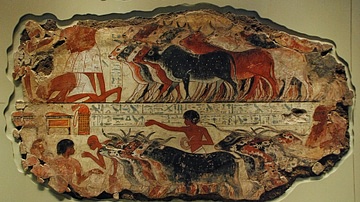
Egyptian Cattle Herd
This painting shows Egyptian cattle being counted by scribes. The painting found part in the tomb of Nebamun (c. 1350 BCE), an wealthy Egyptian accountant ("scribe and counter of grain") during the New Kingdom period. The...

Definition
Sadducees
The Sadducees were part of the upper-class aristocrats and provided much of the priesthood, categorized through the lineage of priestly houses. They served on the Sanhedrin, the city council that organized law courts and regulations...

Definition
Thebes (Egypt)
Thebes was the capital of Egypt during the period of the New Kingdom (c.1570-c.1069 BCE) and became an important center of worship of the god Amun (also known as Amon or Amen, a combination of the earlier gods Atum and Ra). Its...

Definition
Osiris
Osiris is the Egyptian Lord of the Underworld and Judge of the Dead, brother-husband to Isis, and one of the most important gods of ancient Egypt. The name `Osiris' is the Latinized form of the Egyptian Usir which is interpreted as 'powerful'...
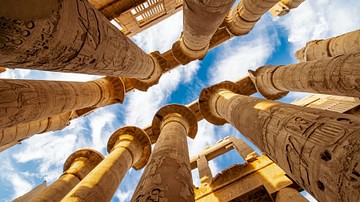
Image Gallery
A Gallery of Ancient Egyptian Temples
The temple in ancient Egypt was the home of the deity it was built for, and the clergy attended the statue of that god or goddess as they would a living person. Every temple was designed with a forecourt, a reception...

Article
Song of Everlasting Sorrow
The Song of Everlasting Sorrow is a narrative poem of the Tang Dynasty (618-907 CE) inspired by the love affair between Xuanzong (r. 712-756 CE), the seventh emperor of the dynasty, and his consort Lady Yang. It was written...

Image
Egyptian Door Jamb
Limestone fragment of a door jamb from the temple of Seth (built by the Egyptian pharaoh Thutmose III) at Ombos (Naqada), Egypt, 18th Dynasty, 1543-1292 BCE. The Petrie Museum of Egyptian Archaeology, London (With thanks to...
