
Search
Remove Ads
Advertisement
Search Results

Image Gallery
A Gallery of Ancient Egyptian Architecture
Architecture in ancient Egypt reflected the Egyptian culture's values, primarily that of ma'at (harmony/balance) symbolized by the symmetry of the completed works. Exteriors and interiors were carefully planned...

Definition
Field of Reeds (Aaru)
A'Aru (The Field of Reeds) was the Egyptian afterlife, an idealized vision of one's life on earth (also known as Sekhet-A'Aru and translated as The Field of Rushes). Death was not the end of life but a transition to another...

Definition
Thoth
Thoth is the Egyptian god of writing, magic, wisdom, and the moon. He was one of the most important gods of ancient Egypt alternately said to be self-created or born of the seed of Horus from the forehead of Set. As the son of these two...

Definition
Nabu - The Babylonian God of Wisdom and Writing
Nabu (sometimes known as Tutu) was the Babylonian god of wisdom, learning, prophecy, scribes, and writing, also responsible for the abundant harvest and all growing things. His name means "the Announcer,"...
Definition
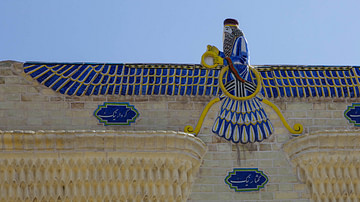
Zarathustra
Zarathustra (also given as Zoroaster, Zartosht, Zarathustra Spitama, l. c. 1500-1000 BCE) was the Persian priest-turned-prophet who founded the religion of Zoroastrianism (also given as Mazdayasna “devotion to Mazda”), the first monotheistic...

Definition
Mesopotamian Government - Helping and Serving the Gods
Ancient Mesopotamian government was based on the understanding that human beings were created to help and serve the gods. The high priest, king, assembly of elders, governors, and any other officials...

Definition
Huldrych Zwingli
Huldrych Zwingli (l. 1484-1531) was a Swiss priest who became the leader of the Protestant Reformation in the region at the same time Martin Luther (l. 1483-1546) was active in Germany. Zwingli is known as the 'third man of the...
Definition
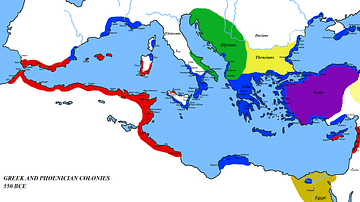
Uat-Ur
Uat-Ur was the ancient Egyptian name for the Mediterranean Sea (also known as Wadj-Wer) and is translated as 'the Great Green'. Uat-Ur was understood as a living entity imbued with the spirit of the divine which, like all other aspects...

Image Gallery
A Gallery of Ancient Egyptian Tombs, Coffins, and Grave Goods
Ancient Egyptian burial practices were observed as early as the Predynastic Period in Egypt (c. 6000 to c. 3150 BCE) and continued through the Ptolemaic Dynasty (323-30 BCE), serving to not...
Image
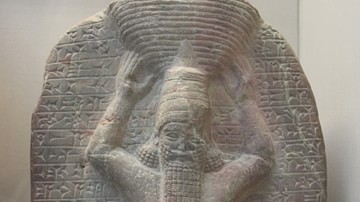
Ashurbanipal as High Priest
Stone stela of Ashurbanipal, the king is shown with a ritual basket of earth on his head as the royal builder for the accession of Shamash-shum-ukin and the restoration of Esagil, the sanctuary of Marduk in Babylon. Cuneiform...
