
Search
Remove Ads
Advertisement
Search Results

Definition
Karnak
Karnak is the modern-day name for the ancient site of the Temple of Amun at Thebes, Egypt. The Egyptians called the site Nesut-Towi, "Throne of the Two Lands", Ipet-Iset, "The Finest of Seats" as well as Ipt-Swt, "Selected Spot" also...
Image
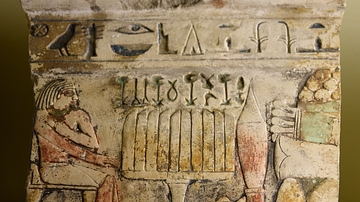
Egyptian stela of offering
This is a part of a painted limestone stela with different colors. A man sits on a lion-legged chair before offerings and a offering table. There is one line of hieroglyphic inscription at the upper part with offering...

Image
Egyptian Broad Collar
Egyptian broad collar in faience. The broad collar is one of the most characteristic elements of ancient Egyptian jewellery. Called wesekh, which means 'the broad one', broad collars are often made up of different rows of...

Video
Anubis: The Egyptian Jackal-Headed God of Mummifaction and the Afterlife
Anubis is the jackal-headed Egyptian god of mummification and the afterlife. He is depicted both as a jackal, and as a man with the head of a jackal. Anubis as a man is often depicted...

Image
Egyptian Cartonnage Mummy Face
A painted linen cartonnage face from an Egyptian female mummy. Third Intermediate Period of Egypt, 21st-22nd Dynasty, 1070-736 BCE.
Egyptian Museum, Turin.
Image
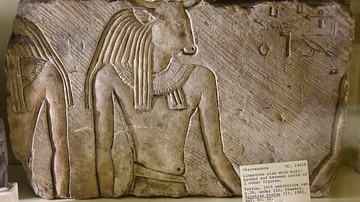
Egyptian Bull-headed deity
This limestone wall-relief block depicts a bull-headed god; the god has a human body and looks to the right side. He is standing between parts of two other partially shown figures. The background wall was left rough. From...

Image
Egyptian Relief showing a butcher and an ox
This limestone fragment of a stela or a block from chapel wall depicts a butcher who cuts up a leg of beef. At the upper part, there is a pile of meat. Some of the the hieroglyphic inscriptions read "meat...
Image
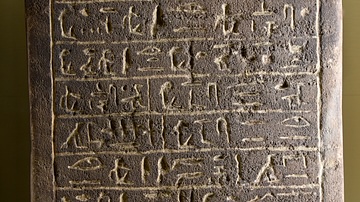
Egyptian stela of Sehetepibre and others
On this sandstone stela, there are 10 lines of hieroglyphs inside the border line. The stela mentions the name of the guard of the bureau of fields, Sehetepibre (born of Ite). From the Tombs of The Courtiers...

Image
Egyptian Casts
Two granite casts, found in Chephren Valley at Giza, Egypt, 4th Dynasty, Old Kingdom of Egypt, 2613-2494 BCE.
The Petrie Museum of Egyptian Archaeology, London (With thanks to The Petrie Museum of Egyptian Archaeology, UCL).
Image
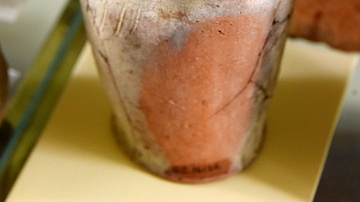
Egyptian Pot in the form of a Mourning Woman
This is a hollow pottery statuette. It depicts a woman mourning; she holds her hands to her head. The statuette is red with a white slip (inverted). From Dandera, Egypt. 11th Dynasty, 2061–1991 BCE. The...
