
Search
Remove Ads
Advertisement
Search Results

Definition
Heka
Heka is the god of magic and medicine in ancient Egypt and is also the personification of magic itself. He is probably the most important god in Egyptian mythology but is often overlooked because his presence was so pervasive as to make...

Definition
Carthaginian Art
The art of the Carthaginians was an eclectic mix of influences and styles, which included Egyptian motifs, Greek fashion, Phoenician gods, and Etruscan patterns. Precious metals, ivory, glass, terracotta, and stone were transformed...
Image
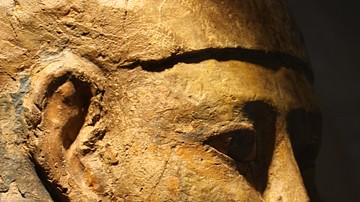
Egyptian Priest Sarcophagus
Egyptian sarcophagus of Ankh-ef-Khons, a priest of Thebes. Wood, 945-712 BCE. (Vannes Archaeological Museum, France)

Image
Egyptian Hieroglyphics
Egyptian hieroglyphic inscription on wood, from the tomb of the general Horemheb. Saqqara, Egypt, c. 1300 BCE. Louvre Museum, Paris, France.

Image
Ancient Egyptian Funeral Painting
Ancient Egyptian tomb painting depicting workmen bringing offerings to a funeral, from the tomb of Nebamun and Ipuky, Thebes, New Kingdom of Egypt (c. 1570 to c. 1069 BCE), 18th Dynasty, c. 1400 BCE. Royal Ontario...

Image
Egyptian God Osiris
Small statue of Osiris.
Staatliches Museum Ägyptischer Kunst (State Museum of Egyptian Art), Munich.
Image
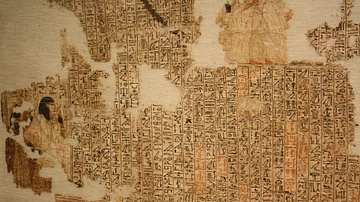
Egyptian Book of the Dead, Pashed Script
A portion of an Egyptian Book of the Dead in the hieroglyphic cursive script of Pashed. Papyrus. XVIII-XIX Dynasty. (Archaeological Museum, Milan, Italy)

Image
Egyptian Djed
A gilded wooden and faience djed amulet (symbol of stability) from the tomb of Queen Nefertari, 19th Dynasty, 1279-1213 BCE.
Egyptian Museum, Turin.
Image
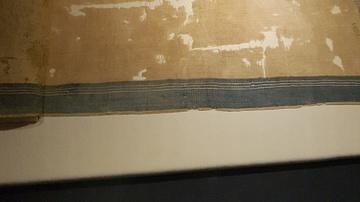
Egyptian Linen
A portion of Egyptian linen. Linen was the most common fabric used by embalmers to wrap the body, often in vast quantities. The woven blue bands on this piece suggest that it once formed part of a garment. New Kingdom to Late Period...

Image
Egyptian Funeral Stele
Plastered and painted funerary stele from the 7th-4th century BCE.
Egyptian Museum, Castello Sforzesco, Milan.
