
Search
Remove Ads
Advertisement
Search Results

Image
Egyptian Beadnet Dress (Detail)
Egyptian beadnet dress from the reign of Khufu, 4th Dynasty, Old Kingdom of Egypt, 2551-2528 BCE. This beadnet dress is the earliest surviving example of a garment with the lozenge pattern. This pattern is frequently...
Image
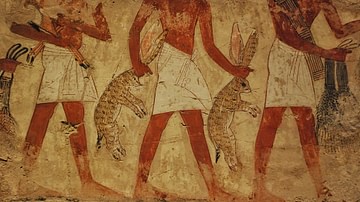
Egyptian Desert Hare Hunting
An Egyptian servant is carrying two desert hares as an offering to Nebamun, a rich Egyptian accountant. Detail of a larger procession of agricultural offerings, from the tomb of Nebamun (c. 1350 BCE). The British Museum...

Image
Face from an Egyptian Coffin
A face of a woman fragment from an Egyptian coffin. New Kingdom of Egypt, 18th-20th Dynasty, 1550-1070 BCE.
Egyptian Museum, Turin.
Image
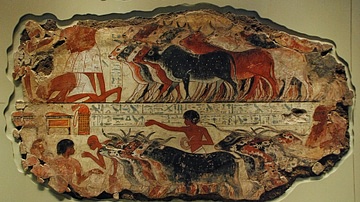
Egyptian Cattle Herd
This painting shows Egyptian cattle being counted by scribes. The painting found part in the tomb of Nebamun (c. 1350 BCE), an wealthy Egyptian accountant ("scribe and counter of grain") during the New Kingdom period. The...

Article
Love, Sex, and Marriage in Ancient Egypt
Although marriages in ancient Egypt were arranged for communal stability and personal advancement, there is evidence that romantic love was as important to the people as it is to those in today. Romantic love...
Image
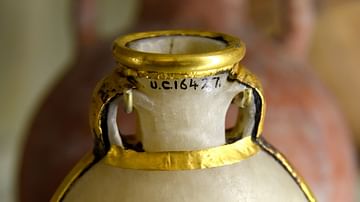
Egyptian Pilgrim Bottle
Gold-mounted alabaster pilgrim bottle. It has a silver foot and was incised with blue-filled cartouches of the Egyptian pharaoh Ramesses II and Queen Nefertari. From Thebes, Egypt. 19th Dynasty, 1292–1189 BCE. The Petrie...

Definition
Ashurbanipal
Ashurbanipal (r. 668-627 BCE, also known as Assurbanipal) was the last of the great kings of Assyria. His name means "the god Ashur is creator of an heir" and he was the son of King Esarhaddon of the Neo-Assyrian Empire. In the Hebrew...
Article
The First Labor Strike in History
The most important cultural value in ancient Egypt was harmony; known to the Egyptians as ma'at. Ma'at was the concept of universal, communal, and personal balance which allowed for the world to function as it should...
Article
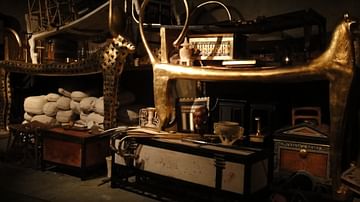
Grave Goods in Ancient Egypt
The concept of the afterlife changed in different eras of Egypt's very long history, but for the most part, it was imagined as a paradise where one lived eternally. To the Egyptians, their country was the most perfect...

Definition
Great Pyramid of Giza
The Great Pyramid of Giza is a defining symbol of Egypt and the last of the ancient Seven Wonders of the World. It is located on the Giza plateau near the modern city of Cairo and was built over a twenty-year period during...
