
Search
Remove Ads
Advertisement
Search Results
Definition
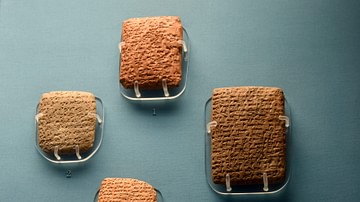
Amarna Letters
The Amarna Letters are a body of 14th-century BCE correspondence exchanged between the rulers of the Ancient Near East and Egypt. They are perhaps the earliest examples of international diplomacy while their most common subjects...

Definition
Cambyses II
Cambyses II (r. 530-522 BCE) was the second king of the Achaemenid Empire. The Greek historian Herodotus portrays Cambyses as a mad king who committed many acts of sacrilege during his stay in Egypt, including the slaying of the sacred...

Definition
Osiris
Osiris is the Egyptian Lord of the Underworld and Judge of the Dead, brother-husband to Isis, and one of the most important gods of ancient Egypt. The name `Osiris' is the Latinized form of the Egyptian Usir which is interpreted as 'powerful'...

Definition
Early Dynastic Period In Egypt - Unification and the Rise of the First Egyptian Kings
The Early Dynastic Period in Egypt (circa 3150 to circa 2613 BCE) is the beginning of the historical era of the country during which the regions of Upper Egypt (south) and...

Definition
Old Kingdom of Egypt - The Age of the Pyramids
The Old Kingdom of Egypt (circa 2613-2181 BCE) is also known as the "Age of the Pyramids" or "Age of the Pyramid Builders" as it includes the great 4th Dynasty when King Sneferu perfected the art of pyramid...

Definition
Apis
Apis was the most important and highly regarded bull deity of ancient Egypt. His original name in Egyptian was Api, Hapi, or Hep; Apis is the Greek name. He is not, however, associated with the god Hapi/Hep who was linked to the inundation...

Definition
Nitocris
Nitocris (2184-2181 BCE) is the Greek name for Nitiqret, the last monarch of the 6th Dynasty of Egypt which concluded the period of the Old Kingdom (c. 2613-2181 BCE). Nitocris is best known from the story told of her by Herodotus (484-425/413...

Image Gallery
A Gallery of Ancient Egyptian Tombs, Coffins, and Grave Goods
Ancient Egyptian burial practices were observed as early as the Predynastic Period in Egypt (c. 6000 to c. 3150 BCE) and continued through the Ptolemaic Dynasty (323-30 BCE), serving to not...
Definition
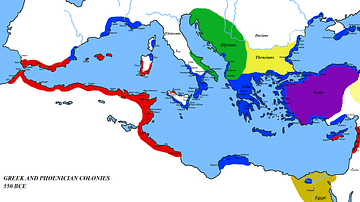
Uat-Ur
Uat-Ur was the ancient Egyptian name for the Mediterranean Sea (also known as Wadj-Wer) and is translated as 'the Great Green'. Uat-Ur was understood as a living entity imbued with the spirit of the divine which, like all other aspects...

Definition
Abraham, the Patriarch
In Judaism, Christianity, and Islam, Abraham is a venerated patriarch whose relationship with God provides the foundational story for God's beneficial relationship with humanity. According to biblical tradition (and some...
