
Search
Remove Ads
Advertisement
Search Results
Image
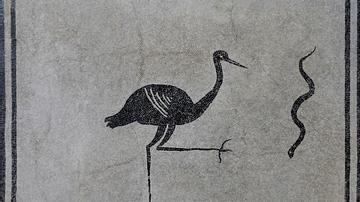
Black and White Mosaic with Stork and Snake
Black and white mosaic floor depicting a stork advancing towards a snake. From the caldarium (hot room of a Roman bath) of Villa della Pisanella at Boscoreale, third quarter of 1st century CE. Now in the...

Article
The Lamentations of Isis and Nephthys
The Lamentations of Isis and Nephthys is an ancient Egyptian text in which the two goddess-sisters call the soul of the god Osiris to rejoin the living. The poem takes the form of a call-and-response liturgy and...

3D Image
Cupid
Cupid, Roman adaptation of the Antonine era (2nd century CE) of a late-Hellenistic creation (2nd century BCE), Rome (?), Marble. Musée du Cinquantenaire (Brussels, Belgium). Made with ReMake and ReCap Pro from AutoDesk. For more updates...
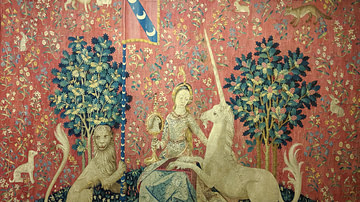
Image Gallery
The Lady and the Unicorn: Medieval Tapestries
The Lady and the Unicorn tapestries, housed at the Musée de Cluny in Paris, are a series of six exquisite medieval tapestries that are renowned for their beauty, craftsmanship, and mysterious symbolism...

Video
The Myth of Echo and Narcissus
Narcissus is a figure from Greek mythology who was so impossibly handsome that he fell in love with his own image reflected in a pool of water. Even the lovely nymph Echo could not manage to tempt him from his self-absorption...

Article
Interrelations of Kerma and Pharaonic Egypt
The vacillating nature of Ancient Egypt's associations with the Kingdom of Kerma may be described as one of expansion and contraction; a virtual tug-of-war between rival cultures. Structural changes in Egypt's...

Article
Polybius' Capture of Achaeus and Fall of Sardis
Polybius' Capture of Achaeus and Fall of Sardis is the account of the end of the Siege of Sardis (215-213 BCE) by Antiochus III (aka Antiochus the Great, r. 223-187 BCE) of the Seleucid Empire after the...

Article
Kingdom of Magadha: Wars and Warfare
In ancient India from the 6th century BCE onwards, the kingdom of Magadha (6th century BCE to 4th century BCE) made a mark for itself. Located in the eastern part of India in what is today the state of Bihar, it...

Article
Plato: The Name and The Poet
Plato (l. c. 424/423 to 348/347 BCE), the Greek philosopher whose works have significantly shaped Western thought and religion, is said to have initially been a poet and playwright and, even if the primary source of...

Article
The Nûñnĕ′hĭ and Other Spirit Folk
The Nûñnĕ′hĭ are the Cherokee "spirit people", similar to the fairy as sometimes depicted in European medieval folklore, and The Nûñnĕ′hĭ and Other Spirit Folk is a collection of anecdotes about them compiled by...
