
Search
Remove Ads
Advertisement
Search Results

Definition
Akkad and the Akkadian Empire - The First Multinational Empire in the World
The city of Akkad was the seat of the Akkadian Empire (2350/2334-2154 BCE), the first multinational political entity in the world, founded by Sargon the Great, who unified Mesopotamia...

Article
Ancient Persian Gods, Heroes, and Creatures - The Complete List
The term 'mythology' comes from the Greek mythos (story-of-the-people) and logos (word or speech), meaning the spoken story of a people. Every civilization of the ancient world developed a...
Image
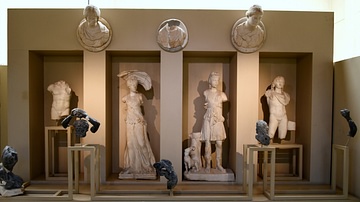
The Battle of the Gods and Goddesses and the Giants
This is the so-called "Silahtarağa Statuary Group". The remains came to light during excavations for the foundations of a building on the road between the quarter Eyub and Alibeykoy near the Golden...

Image
Topographic and Military Map of Stockach and Engen - French and Austrian Positions, 1799–1800
This topographic and military map was created to support the understanding of the Battle of Stockach, won by Archduke Charles in 1799, as well as the Battles of Engen...
Image
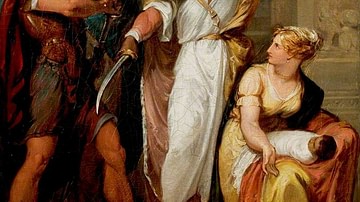
Aaron the Moor, Demetrius and a Nurse and Child
Aaron the Moor, Demetrius and a Nurse and Child from Act IV, Scene 2 in William Shakespeare's Titus Andronicus, painting by Thomas Kirk (1765-1797)
Royal Shakespeare Theatre.

Image
Hedy Lamarr and Victor Mature as Samson and Delilah
Hedy Lamarr and Victor Mature in Samson and Delilah (1949). The ancient Israelite judge Samson was betrayed by his lover Delilah, who was sent to him by his enemies, the Philistines. ©Paramount Pictures...
Image
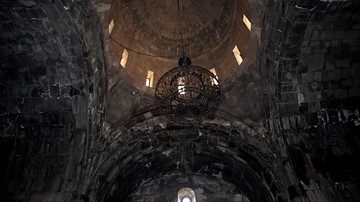
Interior Dome and Arches of St. Pogos and Petros Church
This is the interior dome and arches of the Church of St. Pogos and Petros at Tatev Monastery in Armenia.
Image
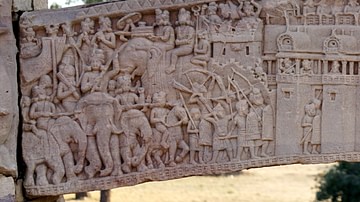
Magadhan and Mauryan Arms and Armour
Details of what soldiers’ arms and armour as well as soldiers themselves in action would have looked like in the 5th century BCE. In all probability, this is how the Magadhan soldiers looked. Details taken from...
Image
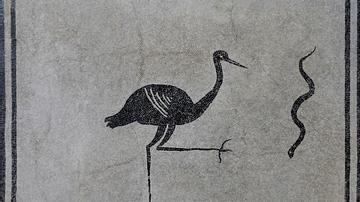
Black and White Mosaic with Stork and Snake
Black and white mosaic floor depicting a stork advancing towards a snake. From the caldarium (hot room of a Roman bath) of Villa della Pisanella at Boscoreale, third quarter of 1st century CE. Now in the...

3D Image
Cupid
Cupid, Roman adaptation of the Antonine era (2nd century CE) of a late-Hellenistic creation (2nd century BCE), Rome (?), Marble. Musée du Cinquantenaire (Brussels, Belgium). Made with ReMake and ReCap Pro from AutoDesk. For more updates...
