
Search
Remove Ads
Advertisement
Search Results

Article
Wihio and Coyote
Wihio and Coyote is a tale of the Cheyenne nation featuring the trickster figure Wihio in the dual role of villain and victim. The trickster figure appears in the stories of many different Native American nations as an often unwilling...

Article
The English and Dutch East India Companies' Invasions of India
In the early 17th century, the Dutch and English East India Companies turned their eyes towards India, as part of their grand schemes to develop extensive trade networks across the Indian and...
Article
Early Media Coverage of the Sand Creek Massacre and Continuing Controversy
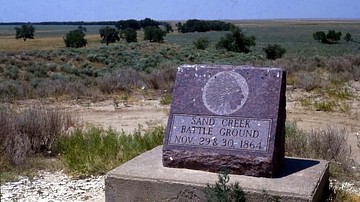
The earliest reports on the Sand Creek Massacre (29 November 1864) characterized it as a great battle in which the Third Colorado Cavalry under Colonel John Chivington defeated a...

Article
Fatima Al-Fihri and Al-Qarawiyyin University
Fatima Al-Fihri (c. 800-880) was a Muslim woman, scholar and philanthropist who is credited with founding the world’s oldest, continuously running university during the 9th century: the University of Al-Qarawiyyin...

Article
The Sky Beings: Thunder and His Helpers
The Sky Beings: Thunder and His Helpers is a legend of the Haudenosaunee (Iroquois) Confederacy of the Six Nations of the Cayuga, Mohawk, Oneida, Onondaga, Seneca, and Tuscarora. The story features the supernatural...

Article
Zwingli's On Rejecting Lent and Protecting Christian Liberty
Although Huldrych Zwingli (l. 1483-1531) began his Reformation efforts in Zürich in 1519, his first break with the Church came in 1522 when he defended a group of citizens who had broken the...

Article
Roman Household Spirits: Manes, Panes and Lares
To the ancient Romans, everything was imbued with a divine spirit (numen, plural: numina) which gave it life. Even supposedly inanimate objects like rocks and trees possessed a numen, a belief which no...

Article
The Woman and the Monster
The Woman and the Monster is a legend of the Arapaho nation about a woman who, seeming to drown in a river, is transported to the realm of an elemental water spirit who teaches her the proper way for her people to honor...

Article
The Masaesyli and Massylii of Numidia
The North African Berber kingdom of Numidia (202-40 BCE) was originally inhabited by a tribe (or federation of tribes) known as the Masaesyli, to the west, and a coalition of smaller tribes, known as the Massylii...

Article
Death and the Afterlife in Ancient Persia
A vision of the afterlife is articulated by every culture, ancient or modern, in an effort to answer the question of what happens after death. Ancient Persia had the same interest in this as any culture of...
