
Search
Remove Ads
Advertisement
Search Results
Image
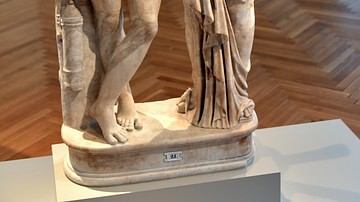
Statue of Amor & Psyche
A marble statue of Amor and Psyche, the lovers from the late 2nd Century CE novel "The Golden Ass" by Lucius Apuleius (125 - 170 CE). The two are depicted as winged children embracing each other. The sculptural group was...
Image
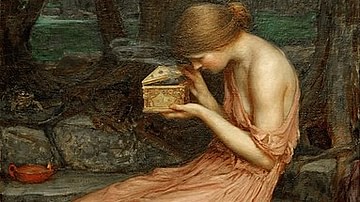
Psyche Opening the Golden Box
Psyche Opening the Golden Box, painting by John William Waterhouse, 1904.

Video
Eros and Psyche: A Valentine’s Story | Mythology w/ Dael Kingsmill
Dael tries not to be cynical about Valentine’s Day this year, instead telling the grand love story of Eros and Psyche. Featuring the Greek version of Cupid, accidents involving magical...

Image
Cupid Frieze, House of the Vettii, Pompeii
A section of the 1st century CE cupids frieze from the triclinium or dining room from the House of the Vetti in Pompeii. The frieze depicts cupids selling flowers and perfumes and as workers who sell flowers...
Image
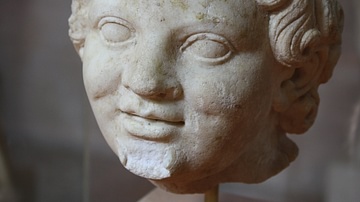
Cupid
Marble head of Cupid (Eros), 1st-2nd century CE. Discovered in the Forum of Ancient Corinth. (Corinth Archaeological Museum Corinth).

Image
Cupid Riding A Dolphin
Cupid on a Dolphin, painting by Erasmus Quellinus II, 1630 CE.
Museo del Prado, Madrid.

Video
The History of Valentines Day: From the Lupercalia to Cupid
Before chocolates, roses and letters from your valentine were given on Valentines Day, there was the Ancient Roman Festival of the Lupercalia in honour of both the agricultural god Luperca and...

Definition
Eros
Eros was the Greek god of love, or more precisely, passionate and physical desire. Without warning Eros selects his targets and forcefully strikes at their hearts, bringing confusion and irrepressible feelings. In the words of Hesiod...

Definition
Mythology
Myths are a part of every culture in the world and are used to explain natural phenomena, where a people came from and how their civilization developed, and why things happen as they do. At their most basic level, myths comfort by...

Article
Patrons & Artists in Renaissance Italy
During the Renaissance, most works of fine art were commissioned and paid for by rulers, religious and civic institutions, and the wealthy. Producing statues, frescoes, altarpieces, and portraits were just some...
