
Search
Remove Ads
Advertisement
Search Results

Book Review
Streams of Gold, Rivers of Blood: The Rise and Fall of Byzantium, 955 A.D. to the First Crusade (Onassis Series in Hellenic Culture)
When Basil II died in 1025 CE, the empire he left behind stretched from Sicily to the Crimea. His long reign was the pinnacle of one...

Book Review
Romanland: Ethnicity and Empire in Byzantium
Those familiar with Byzantine history are aware that the Byzantines referred to themselves as Romans and lived in what they still considered the Roman Empire, or Romanía. But despite this well-known fact...

Book Review
The Samurai Encyclopedia: A Comprehensive Guide to Japan's Elite Warrior Class
This is a paperback edition of a book that was first published as a hardback in 2019. The author, Constantine Nomikos Vaporis, is a professor of history at Maryland University...

Book Review
Hadrian's Wall: Everyday Life on a Roman Frontier
Patricia Southern's writing breathes wit and entertainment into her treatment of Hadrian's Wall. Hadrian's Wall: Everyday Life on a Roman Frontier could easily have been yet another dry interpretation...

Book Review
The Eternal Decline and Fall of Rome: The History of a Dangerous Idea
In the book's Introduction, Edward Watts sets out his premise clearly. Roman politicians grew their power by destabilizing the present conditions of their society. As Watts points out...

Definition
Trebizond
Trapezus (Greek: Τραπεζοῦς) or Trebizond was a Greek city on the southern shore of the Black Sea, modern Trabzon. According to the Christian author Eusebius, writing more than a millennium after the event, Trapezus was founded in 756...

Article
North Africa During the Classical Period
Phoenician traders arrived on the North African coast around 900 B.C. and established Carthage (in present-day Tunisia) around 800 B.C. By the sixth century B.C., a Phoenician presence existed at Tipasa (east...

Article
Continuity and Change after the Fall of the Roman Empire
The cataclysmic end of the Roman Empire in the West has tended to mask the underlying features of continuity. The map of Europe in the year 500 would have been unrecognizable to anyone living a...

Image
Sikh Empire Cannon
A cannon used by the Sikh Empire during the First Anglo-Sikh War (1845-6) against the British East India Company. This example was captured after the Battle of Ferozeshah in December 1845. The photograph was taken by John Constantine...
Image
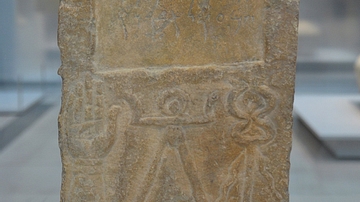
Punic Stele with Goddess Tanit
Punic stele with a crescent moon and the sign of the Phoenician goddess of fertility Tanit, found in Cirta (ancient Constantine, Algeria), around 300-200 BCE. Now in Louvre Lens, France.
