
Search
Remove Ads
Advertisement
Search Results

Definition
Temple at Uppsala
The Temple at Uppsala was a religious center dedicated to the Norse gods Thor, Odin, and Freyr located in what is now Gamla Uppsala in Sweden. It is described by the 11th-century historian Adam of Bremen as the most significant...

Definition
John Calvin
John Calvin (l. 1509-1564) was a French Reformer, pastor, and theologian considered among the greatest of the Protestant Reformation along with Martin Luther (l. 1483-1546) and Huldrych Zwingli (l. 1484-1531). Calvin synthesized the...
Definition
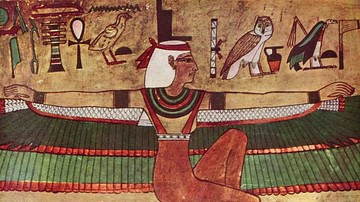
Isis
Isis is an ancient Egyptian goddess who became the most popular and enduring of all the Egyptian deities. Her name comes from the Egyptian Eset, ("the seat") which referred to her stability and also the throne of Egypt as she was considered...

Definition
Leif Erikson
Leif Erikson (also spelled Leif Eriksson, Old Norse Leifr Eiríksson), nicknamed Leif 'the Lucky', was a Norse Viking who is best known for arguably being the first European to have set foot on North American soil along with his crew...

Definition
Ragnarök - The Cataclysmic Battle of Norse Mythology
Ragnarök is the cataclysmic battle between the forces of chaos and those of order in Norse mythology, ending the world and killing most of the gods and their adversaries, leading to the birth of a new...

Definition
Northern Crusades
The Northern or Baltic Crusades were military campaigns organised by popes and western rulers to convert pagans to Christianity in the 12th to 15th century. Unlike in the Holy Land, where military campaigns were aimed at liberating...

Definition
Kingdom of Kongo
The Kingdom of Kongo (14-19th century CE) was located on the western coast of central Africa in modern-day DR of Congo and Angola. Prospering on the regional trade of copper, ivory, and slaves along the Congo River, the kingdom's...

Article
The Integration of Church and State in the Roman Empire
In the ancient world, "religion" and society were not separate entities. Various gods dictated covenants, "law-codes," and social conventions. Such law-codes were most often the responsibility of...

Article
How the Pacific War Changed Global Warfare
The Pacific War (1941-45) contributed many lasting innovations and developments to global warfare. This theatre of the Second World War witnessed the end of battleships as the primary mode of naval warfare...

Article
Christian Antisemitism in the Middle Ages & during the Reformation
Antisemitism is a modern term that describes prejudice and hostility to Jews and Judaism. The origins of Christian antisemitism in the gospels are based on the story of a 1st-century itinerant...
