
Search
Remove Ads
Advertisement
Search Results
Definition
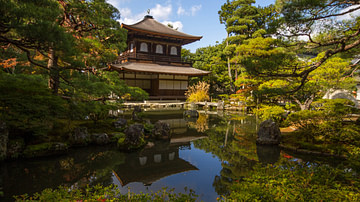
Ginkakuji
The Ginkakuji Temple in Kyoto, Japan, formally referred to as Jisho-ji and otherwise known as 'The Serene Temple of the Silver Pavilion', was first built in the 15th century CE. It is a Rinzai Zen temple with the complex consisting...

Definition
Silk in Antiquity
Silk is a fabric first produced in Neolithic China from the filaments of the cocoon of the silk worm. It became a staple source of income for small farmers and, as weaving techniques improved, the reputation of Chinese silk spread...

Definition
Three Kingdoms Period in Korea
The Three Kingdoms Period of ancient Korea (57 BCE – 668 CE) is so-called because it was dominated by the three kingdoms of Baekje (Paekche), Goguryeo (Koguryo), and Silla. There was also, though, a fourth entity...

Definition
Saichō
Saichō, also known as Dengyo Daishi (767-822 CE), was a monk and scholar who founded the Buddhist Tendai Sect in Japan. Based on the teachings of the Chinese Tiantai Sect, Saichō's simplified and inclusive version of Buddhism grew in...

Definition
The Great Game - Britain and Russia's Imperial Rivalry
The Great Game describes the rivalry between the British and Russian empires through the 19th century. The game was primarily concerned with the control of certain regions in Central Asia and the...
Definition
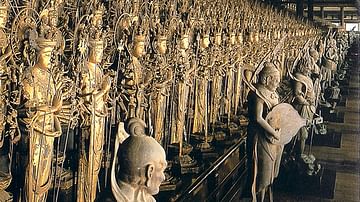
Sanjusangendo
Sanjusangendo is a Buddhist temple which is part of the Rengeo-in monastery in Kyoto, Japan. Founded in 1164 CE, the temple is famous for its impressive dimensions and the 1,001 golden Buddha figures and 28 guardian statues which...

Article
Religion in the Middle Ages
Religion in the Middle Ages, though dominated by the Catholic Church, was far more varied than only orthodox Christianity. In the Early Middle Ages (c. 476-1000), long-established pagan beliefs and practices entwined...

Image
Allied POWS in Japan
Two British prisoners of war being made to work the land in the Japanese prison camp at Ube, Japan, in 1943-44, during WWII's Pacific War.
Imperial War Museums, London.
Image
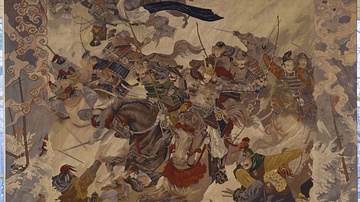
The Mongol Invasion of Japan
"The Mongol Invasion" is a Japanese silk tapestry by Kawashima Jimbei II (Japanese, 1853 - 1910 CE), based on an oil painting by Morizumo Yugyo (1854 - 1927 CE). The painting depicts the Mongol Empire's failed invasions...
Image
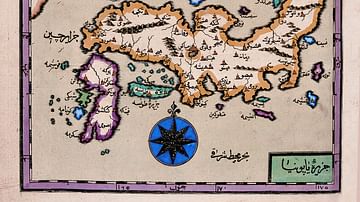
Map of Japan by Katip Çelebi
Map of Japan by Katip Çelebi (d. 1657), geographer of the Ottoman Empire, in his famous geographic dictionary, Kitab-ı Cihannüma (View of the World).
Cambridge University Library.
