
Search
Did you mean: Assyria?
Remove Ads
Advertisement
Search Results
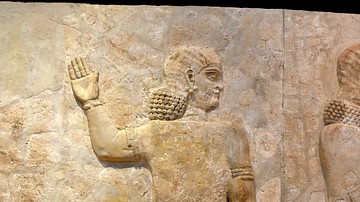
Image
Assyrian Master of Ceremonies
Alabaster-bas relief, part of a long tributary scene, where the Assyrian king, Sargon II (not shown here), stands majestically, waiting to receive the tribute from Urartu (modern-day Armenia). From the Royal Palace of Sargon II at Khorsabad...
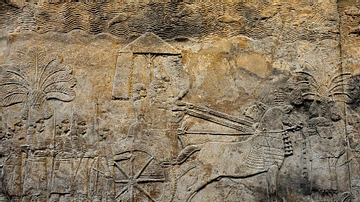
Image
Assyrian Military Campaign in Southern Mesopotamia
The Assyrian king in a chariot watches as prisoners are brought in and heads and booty are piled-up in a palm grove. Neo-Assyrian era, 640-620 BCE, Mesopotamia, Iraq. From Nineveh, south-west palace, court XIX, panels 10-12. (The British...
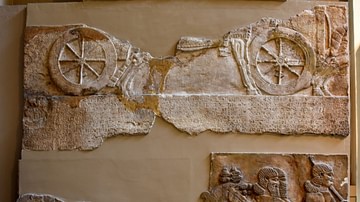
Image
Assyrian Chariots
Assyrian wall panel, from the Central Palace at Nimrud (ancient Kalhu), Mesopotamia, modern-day Iraq, reused later in the South-West Palace, from the reign of Tiglath-Pileser III, c. 728 BCE. One of a series, it shows two disconnected scenes...
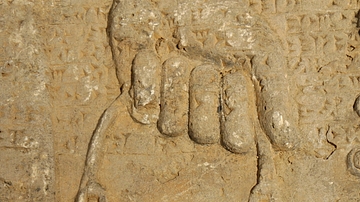
Image
Assyrian Ceremonial Bucket (Banduddu)
This is a close-up image of an Assyrian bucket (banduddu) held by a protective spirit (Apkallu). During certain ceremonies, this bucket was filled with a fluid and the Apkallu dips a pine cone (mullilu) into it; the Apkallu then sprinkles...
Image
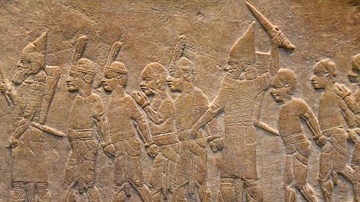
Assyrian Soldiers with Nubian Prisoners
This is a detail of a large gypsum wall panel. The panel depicts the Assyrian attack on a fortress at the Egyptian city of Memphis in 667 BCE. Here the Nubian soldiers of King Taharqa (of the 25th Dynasty) are being led, as prisoners, by...
Image
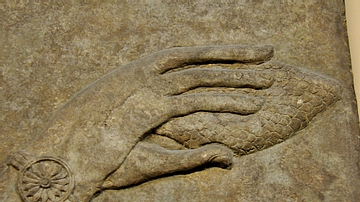
Assyrian Mullilu
This is a close-up image of a hand carrying an Assyrian mullilu; mullilu is an Akkadian word which means a purifier. This object, most likely a pine cone, was dipped into a certain liquid and then sprinkled on the Assyrian king and his courtiers...
Image
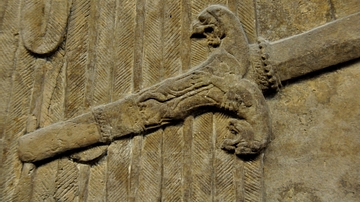
Assyrian Sword Sheath
A close-up image of the lower end of an Assyrian sword's sheath.The sheath's end has been decorated with bodies of 2 roaring lionesses. The sword depicted on this alabaster bas-relief belongs to an Assyrian attendant and the feathers on...
Image
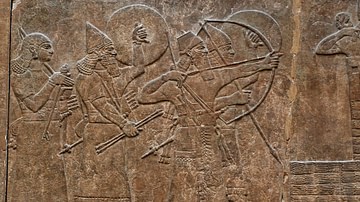
Assyrian Siege
This Assyrian relief from the North-West Palace in Kalhu (c. 865-860 BCE) shows King Ashurnasirpal advancing on an enemy city, protected by a shield-bearer. Ahead is a wheeled siege engine, which carries more archers and contains a lever-operated...
Image
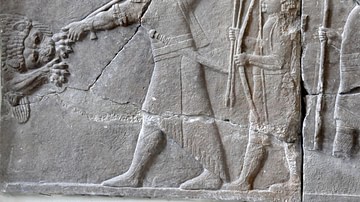
Assyrian Lion Hunt Relief, Nineveh
Gypsum wall relief depicting the typical royal hunting of lions, part of a longer sequence. The king, Ashurbanipal II, thrusts a spear onto a leaping and furious lion. Behind him, an Elamite squire assists him. Partially appearing on the...
Image
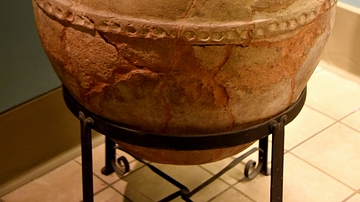
Assyrian Storage Jar
This jar was found in one of the wine-cellars in the arsenal at Nimrud (ancient Kalhu). It is marked in cuneiform with its capacity; 1 homer, 3 seah, 7 qa. In fact, it holds about 300 liters. Assyrian, late 7th century BCE. From Nimrud, Mesopotamia...
