
Search
Did you mean: Assyria?
Remove Ads
Advertisement
Search Results

Article
Wall Reliefs: Apkallus of the North-West Palace at Nimrud
Religion is the sigh of the oppressed creature, the heart of a heartless world, and the soul of soulless conditions. It is the opium of the people. (Karl Marx, Critique of Hegel's Philosophy of Right). When it comes to religion, many people...

Definition
Tiglath Pileser III
Tiglath Pileser III (745-727 BCE) was among the most powerful kings of the Neo-Assyrian Empire and, according to many scholars, the founder of the empire (as opposed to the claims for Adad Nirari II (912-891 BCE) or Ashurnasirpal II (884-859...
Video
Assyrian Relief from the Palace of Ashurnasirpal II
Monique Seefried, consulting curator of Near Eastern Art at the Michael C. Carlos Museum, describes this stone palace wall relief panel of an Assyrian winged deity from the Palace of Ashurnasirpal II (reigned 883-859 BCE) from the ancient...
Video
Assyrian Palace Reliefs (82nd & Fifth)
http://82nd-and-fifth.metmuseum.org/hyperreality Explore this object: http://82nd-and-fifth.metmuseum.org/relief-panel-assyrian-32.143.4 "That infinite image creates an endless echoing, which is almost dizzying and supernatural."...

Definition
Sennacherib
Sennacherib (r. 705-681 BCE) was the second king of the Sargonid Dynasty of Assyria (founded by his father Sargon II, r. 722-705 BCE). He is one of the most famous Assyrian kings owing to the part he plays in narratives in the biblical Old...

Definition
Sargonid Dynasty
The Sargonid Dynasty was the last ruling house of the Neo-Assyrian Empire from 722-612 BCE, beginning with the reign of Sargon II and ending with fall of the Neo-Assyrian Empire. Some of the most famous kings in the history of Assyria come...

Definition
Ashurbanipal
Ashurbanipal (r. 668-627 BCE, also known as Assurbanipal) was the last of the great kings of Assyria. His name means "the god Ashur is creator of an heir" and he was the son of King Esarhaddon of the Neo-Assyrian Empire. In the Hebrew Tanakh...
Image
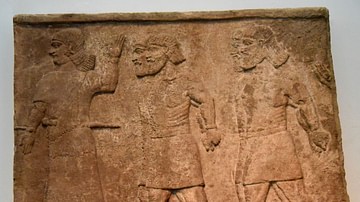
Review of Arab Prisoners, Assyrian Relief
Assyrian relief, from the Central Palace at Nimrud (ancient Kalhu), Mesopotamia, Iraq, Neo-Assyrian Empire, c. 728 BCE. This is part of a series of reliefs showing Arab prisoners brought before the Assyrian King Tiglath-Pileser III (r. 744-727...

Definition
Assur - The Supreme God of the Ancient Assyrians
Assur (also Ashur, Anshar) is the god of the ancient Assyrians who was elevated from a local deity of the city of Ashur to the supreme god of the Assyrian pantheon. His attributes were drawn from earlier Sumerian and Babylonian deities, and...
Definition
Sargon II
Sargon II (r. 722-705 BCE) was one of the most important kings of the Neo-Assyrian Empire as founder of the Sargonid Dynasty which would rule the empire for the next century until its fall. He was a great military leader, tactician, patron...
