
Search
Did you mean: Assyria?
Remove Ads
Advertisement
Search Results

Definition
Assyrian Warfare
Assyria began as a small trading community centered at the ancient city of Ashur and grew to become the greatest empire in the ancient world prior to the conquests of Alexander the Great and, after him, the Roman Empire. While the Assyrians'...

Definition
Neo-Assyrian Empire
The Neo-Assyrian Empire (912-612 BCE) was the final stage of the Assyrian Empire, stretching throughout Mesopotamia, the Levant, Egypt, Anatolia, and into parts of Persia and Arabia. Beginning with the reign of Adad Nirari II (912-891 BCE...

Definition
Assyria
Assyria was the region located in the ancient Near East which, under the Neo-Assyrian Empire, reached from Mesopotamia (modern-day Iraq) through Asia Minor (modern Turkey) and down through Egypt. The empire began modestly at the city of Ashur...

Article
Assyrian reliefs
Mostly dating from the period 880-612 BCE, these carved scenes are found on free-standing stelae and as panels cut on cliffs and rocks at distant places reached by the Assyrian kings during their campaigns. The most spectacular use of stone...

Article
Wall Reliefs: Ashurnasirpal II's War Scenes at the British Museum
The Mighty King 600 of their warriors I put to the sword and decapitated; 400 I took alive; 3,000 captives I brought forth; I took possession of the city for myself: the living soldiers, and heads to the city of Amidi the royal city, I sent...

Image Gallery
A Gallery of Assyrian Warfare
The Assyrian military was the most effective – and feared – fighting force in the Near East, especially during the time of the Neo-Assyrian Empire, 912-612 BCE, when their territory expanded across Mesopotamia, the Levant, into Asia Minor...

Image
Assyrian Soldiers Engaging with Nubian Soldiers at Memphis
Detail of a large gypsum wall panel showing the Assyrian army attacking the Egyptian city of Memphis and commemorating the final victory of the Assyrian king Ashurbanipal II over the Egyptian king Taharqa in 667 BCE. Panel 17, Room M of the...

Image Gallery
A Gallery of Neo-Assyrian Kings
The Neo-Assyrian kings are among the best-known of the Assyrian Empire and include Tiglath Pileser III, Shalmaneser III, Sargon II, Sennacherib, Esarhaddon, and Ashurbanipal. The term Neo-Assyrian is a modern-day designation; the Assyrians...
Image
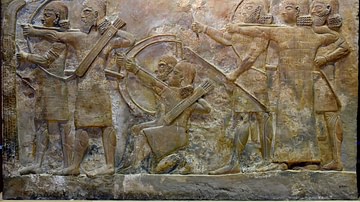
Assyrian Archers from Khorsabad
Assyrian relief depicting a group of Assyrian archers attacking an enemy (not shown here), from the Royal Palace of Sargon II at Khorsabad, in modern-day Nineveh Governorate, Iraq, c. 710 BCE. A soldier holding a large and long shield stands...

Image
Assyrian Soldiers Holding Decapitated Heads of Nubian Soldiers
Detail of a large gypsum wall panel, depicting the Assyrian attack on a fortress at the Egyptian city of Memphis in 667 BCE, Panel 17, Room M of the North Palace at Nineveh, Northern Mesopotamia, modern-day Iraq, Neo-Assyrian Empire, 645-635...
