
Search
Did you mean: Assyria?
Remove Ads
Advertisement
Search Results
Image
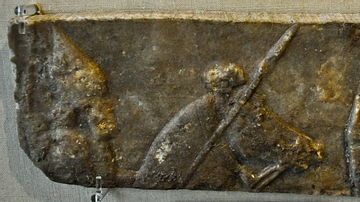
Assyrian Cavalrymen
A fragment of an alabaster bas-relief which depicts Assyrian cavalrymen (in a war scene?). From Kuyunjik (modern-day Ninawa Governorate, Iraq). Neo-Assyrian period, reign of Ashurbanipal, 668-627 BCE. The Burrell Collection, Glasgow, Scotland...
Image
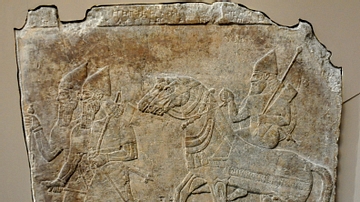
Assyrian Soldiers in Lebanon
This gypsum wall relief was part of a corner panel. It depicts Assyrian soldiers with horses crossing a mountainous area. The wavy lines and spirals at the bottom of the scene represent a river. The cuneiform inscriptions on the reverse refer...
Image
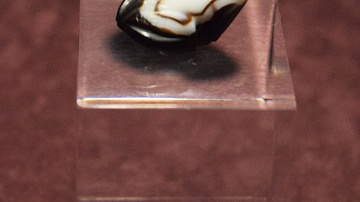
Assyrian Frog-Shaped Weight
This Assyrian frog-shaped weight dates from the 16th-15th century BCE and is made of sardonyx. It has a Middle Assyrian cuneiform inscription along the frog's back. (Metsamor Historical-Archaeological Museum-Reserve, Taronik, Armenia)
Image
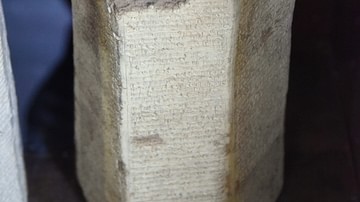
Assyrian Prism of Esarhaddon
Hexagonal clay prism with cuneiform inscription narrating the military campaigns of the Assyrian king Esarhaddon (r. 680-669 BCE). Later on, the upper aspect was used a candle holder by the owner. Probably from Nineveh, Mesopotamia, modern-day...
Image
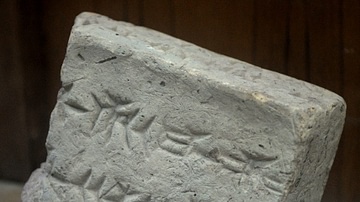
Assyrian Cuneiform Brick
The cuneiform inscriptions on this mud-brick mention the name of Ashurnasirpal II, the Assyrian king. From northern Mesopotamia, modern-day Iraq. Neo-Assyrian period, reign of Ashurnasirpal II, 883-859 BCE. The Sulaymaniyah Museum, Iraq.

Image
Assyrian Courtiers Carrying the King's Throne
This gypsum wall panel depicts a procession of Assyrian courtiers and eunuchs carrying the King's throne; only the anterior part of the decorated throne's pole survives. This scene represents a remarkable development in the Assyrian art as...

Image
Assyrian Lion Hunt Relief
Frieze depicting a lion hunt, from the royal palace of Ashurbanipal, Nineveh, modern-day Iraq. Neo-Assyrian Empire, 668-631 BCE. The king's role was to protect his people from enemies. In ancient Assyria, this was symbolized in the lion...

Image
Assyrian Amulet
This bronze plaque represents an amulet against bad spirits and diseases. From northern Mesopotamia (modern-day Iraq). Assyrian. Istanbul Archaeological Museums/Ancient Orient Museum, Istanbul, Turkey.
Image
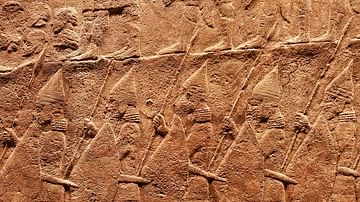
Assyrian Soldiers
Assyrian soldiers armed with shield, spear, and helmet (c. 700-692 BCE). They represent the army of King Sennacherib of Assyria (reigned 705-681 BCE) marching on Lachish, an ancient town about 40 km from Jerusalem. This image is part of a...
Image
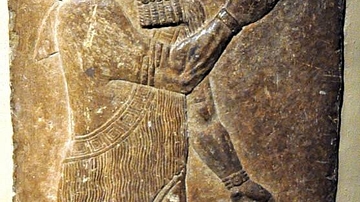
Assyrian Protective Spirit from Khorsabad
This gypsum wall relief of a protective spirit (sage) was found at the palace of Sargon II at the city of Khorsabad (ancient Dur-Sharrukin), northern Mesopotamia. Iraq. Neo-Assyrian period, 710-705 BCE. (The British Museum, London).
