
Search
Remove Ads
Advertisement
Search Results
Definition
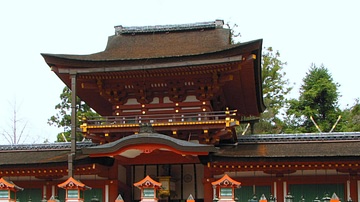
Kasuga Taisha
Kasuga Taisha is an ancient Shinto shrine located in a forest east of Nara, capital of Japan between 710 and 784 CE. Founded in 768 CE, the site has four main shrines in honour of four Shinto-Buddhist deities, one of which is the...

Definition
Yomi
Yomi, or Yomi-tsu-kuni, is the underworld of the Shinto religion, even if it forms no part of Shinto theology and appears only in ancient myths as told in the 8th-century CE Kojiki, notably the story of the creator gods Izanami and Izanagi...

Definition
Foot-Binding
Foot-binding was a practice first carried out on young girls in Tang Dynasty China to restrict their normal growth and make their feet as small as possible. Considered an attractive quality, the effects of foot-binding were painful...

Definition
Samurai Sword
Swords used by Japanese samurai were renowned for the craftsmanship which produced strong yet flexible curved steel blades with a single, super-sharp cutting edge. Produced from the 8th century CE onwards and symbolic of the samurai's...

Definition
Ilkhanate
The Ilkhanate (or Ilqanate, 1260-1335 CE) was that part of the Mongol Empire (1206-1368 CE) which mostly covered what is today Iran and parts of Turkmenistan, Turkey, Iraq, Armenia, Afghanistan, and Pakistan. Established by the Mongol...

Definition
Goguryeo
Goguryeo (Koguryo) was a kingdom which ruled northern Korea during the Three Kingdoms period from the 1st century BCE to 7th century CE. The kingdom flourished in the 5th and 6th century CE and has left a rich cultural heritage best...

Definition
Longmen Grottoes
The Longmen Grottoes, a Buddhist cave complex located 13 kilometers south of Luoyang in China's Henan province, form some of the most significant and exquisite representations of ancient Chinese stone art. Created over the course...

Definition
Yama
Yama is the Hindu god of death, king of ancestors, and final judge on the destination of souls. He is also known as the 'Restrainer', Pretaraja or 'King of Ghosts', Dharmaraja or 'King of Justice', and as Daksinasapati is considered the...

Definition
Emperor Taizong of Tang
Taizong (birth name, Li-Shimin, l. 598-649 CE, r. 626-649 CE) was the second emperor of the Tang Dynasty and is considered one of the greatest rulers in Chinese history for his reforms of the government and the laws, his...

Definition
Brahmi Script
The Brahmi script is the earliest writing system developed in India after the Indus script. It is one of the most influential writing systems; all modern Indian scripts and several hundred scripts found in Southeast and East Asia...
